
World History

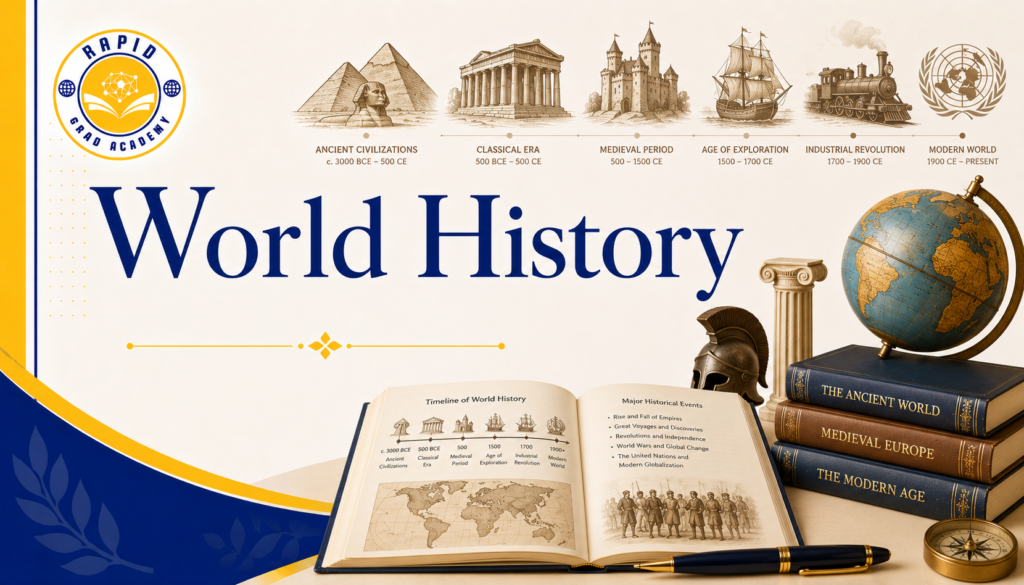
Human civilization from the first farmers to the present, studied through evidence, causation and the perspectives of the people who lived it.

0.0
(0)
2 Enrolled

About Course

World History traces human civilization from the first farming villages to the
present day — but it is not a list of dates to memorise. It teaches you to think historically: to
weigh evidence, distinguish a trigger from a cause, recognise whose voice a source represents, and
trace how the present was produced.

The course covers every inhabited region rather than treating Europe as the centre and everywhere
else as background. The Islamic Golden Age, West African trading empires, Tang China, the Inca and
the Maya appear here as major civilizations, because that is what they were.

What you will study

  • Unit 1 — Foundations and the First Civilizations: the Neolithic Revolution,
    Mesopotamia, Egypt, the Indus Valley, Shang China, and how to read historical sources.
  • Unit 2 — Classical Civilizations: Greece, Rome, classical India and China, and
    the origins of the major world belief systems.
  • Unit 3 — The Post-Classical World: Byzantium, the rise of Islam, medieval Europe,
    African and American civilizations, global trade and the Black Death.
  • Unit 4 — Transformation, 1400–1800: Renaissance, Reformation, the Columbian
    Exchange, the Atlantic slave trade, the Enlightenment and the Atlantic revolutions.
  • Unit 5 — Industry, Empire and Nationalism: the Industrial Revolution, nation
    states, imperialism and the movements that resisted them.
  • Unit 6 — The Modern World: the world wars, the Holocaust, the Cold War,
    decolonisation and globalisation.

How the course works

Most of your time is spent on teaching lessons built around evidence and explanation. Each unit
includes two interactive activities you complete on screen — source analysis, comparison charts and
causation exercises, typed directly into the worksheet — and one unit quiz marked automatically. A
mid-course assessment follows Unit 3 and a final assessment closes the course.

Some units deal with difficult subjects including slavery, colonial violence and genocide. These
are handled factually and without graphic detail, because understanding how such events happened is
the most reliable protection against repeating them.

What you will be able to do

By the end you will carry a working map of world history and, more usefully, the ability to
analyse a source rather than simply accept it, and to trace a current issue back to what produced
it.

Show More

What Will You Learn?

  • Analyse primary and secondary sources and assess their reliability
  • Explain change over time using cause, effect and contingency
  • Compare civilizations and belief systems across regions and eras
  • Connect historical developments to the world you live in now
  • Construct historical arguments supported by specific evidence

Requirements

  • No prior history required. Confident reading and willingness to weigh evidence.

Audience

  • Students beginning their high school social studies requirement, and learners who want the global context needed for United States History, Government and Economics.

Course Content

Getting Started
<p>How this course works, what you will learn, and how you are assessed.</p>

  • Course Overview and Learning Objectives

Unit 1: Foundations and the First Civilizations
<h2>Unit Introduction</h2> <p>For roughly 95% of human existence, people lived in small mobile groups, hunting and gathering. Then, in the space of a few thousand years, humans in several unconnected parts of the world began farming — and almost everything else followed: permanent settlement, surplus food, cities, writing, government, social hierarchy and war.</p> <p>This unit examines that transition and the four river valley civilizations it produced. It also introduces the skill this entire course depends on: <strong>reading a source for what it can and cannot tell you.</strong></p> <h2>Unit Learning Objectives</h2> <p>By the end of Unit 1 you will be able to: - Explain the Neolithic Revolution and its consequences - Identify the shared features of early civilizations - Compare Mesopotamia, Egypt, the Indus Valley and Shang China - Distinguish primary from secondary sources and assess their reliability</p>

Unit 2: Classical Civilizations
<h2>Unit Introduction</h2> <p>Between roughly 800 BCE and 500 CE, several societies produced ideas and institutions that outlasted them by two thousand years: Greek philosophy and democracy, Roman law and engineering, Indian mathematics, Chinese bureaucracy, and the major world religions.</p> <p>They are called <strong>classical</strong> because later societies repeatedly returned to them as models — and that repeated return is itself a historical fact worth examining. Ideas do not survive because they are good; they survive because someone chooses to preserve and revive them.</p> <h2>Unit Learning Objectives</h2> <p>By the end of Unit 2 you will be able to: - Compare Athenian democracy with Spartan oligarchy, and assess their limits - Explain Rome's transition from republic to empire and the debate about its fall - Describe classical Indian and Chinese achievements and systems of government - Compare the origins and core ideas of the major world belief systems</p>

Unit 3: The Post-Classical World
<h2>Unit Introduction</h2> <p>The thousand years after Rome's western collapse used to be called the Dark Ages. That label is now abandoned, for two reasons: it described only western Europe, and even there it was misleading.</p> <p>While western Europe reorganised around local lordship, the Byzantine Empire preserved Roman law and Greek learning, the Islamic world became the leading centre of science and medicine, West African empires grew rich on trans-Saharan trade, and Chinese technology ran centuries ahead of Europe's.</p> <p>This unit examines those societies and the trade networks that increasingly connected them — as well as what those networks carried besides goods.</p> <h2>Unit Learning Objectives</h2> <p>By the end of Unit 3 you will be able to: - Describe the Byzantine Empire and the rise and expansion of Islam - Explain feudalism and the structure of medieval European society - Describe major African, American and Asian societies of the period - Analyse the Silk Road, Indian Ocean trade and the Black Death</p>

Unit 4: Transformation, 1400–1800
<h2>Unit Introduction</h2> <p>Four centuries in which European societies changed more than in the previous thousand years — and, through exploration and conquest, changed the rest of the world permanently.</p> <p>This unit covers the Renaissance and Reformation, the voyages that connected the hemispheres for the first time, the Scientific Revolution and Enlightenment, and the revolutions those ideas helped produce. It also examines the human cost of the connection, which was enormous and fell almost entirely on people who had no say in it.</p> <h2>Unit Learning Objectives</h2> <p>By the end of Unit 4 you will be able to: - Explain the Renaissance and the causes and consequences of the Reformation - Analyse the Columbian Exchange and the Atlantic slave trade - Describe the Scientific Revolution and Enlightenment ideas - Compare the American and French Revolutions and their outcomes</p>

Unit 5: Industry, Empire and Nationalism, 1750–1914
<h2>Unit Introduction</h2> <p>The Industrial Revolution changed how people worked, where they lived, what they owned and how long they lived — more profoundly than any change since farming began.</p> <p>It also supplied the means and the motive for a second wave of European expansion. By 1914 a handful of European states, plus the United States and Japan, controlled most of the world's land surface.</p> <p>This unit examines how that happened, what it cost, and how people resisted it.</p> <h2>Unit Learning Objectives</h2> <p>By the end of Unit 5 you will be able to: - Explain why industrialisation began in Britain and describe its social effects - Describe nationalism and the unification of Germany and Italy - Analyse the causes, methods and consequences of New Imperialism - Describe movements that resisted or reformed these systems</p>

Unit 6: The Modern World, 1914–Present
<h2>Unit Introduction</h2> <p>The twentieth century produced the deadliest wars in history, the most destructive weapons ever built, and the collapse of the empires that had dominated the globe in 1914.</p> <p>It also produced decolonisation, the Universal Declaration of Human Rights, and a degree of global interconnection without precedent. This unit traces how the rivalries of Unit 5 produced catastrophe, what was built afterwards, and how the world reached its present arrangement.</p> <p>Some of the material in this unit is difficult. It is included because understanding how these events happened is the most reliable protection against their repetition.</p> <h2>Unit Learning Objectives</h2> <p>By the end of Unit 6 you will be able to: - Explain the causes, course and settlement of the First World War - Describe the rise of totalitarian regimes between the wars - Explain the Second World War and the Holocaust - Analyse the Cold War, decolonisation and globalisation</p>

Course Completion
<p>Final assessment and full-course review.</p>

Instructors

Rapid Grad Academy

Rapid Grad Academy

4.3
6 Students
25 Courses
No Review Yet
No Review Yet