
Earth Science
The planet you live on, studied from four directions: its rocks, its water, its air, and its place in space.
About Course
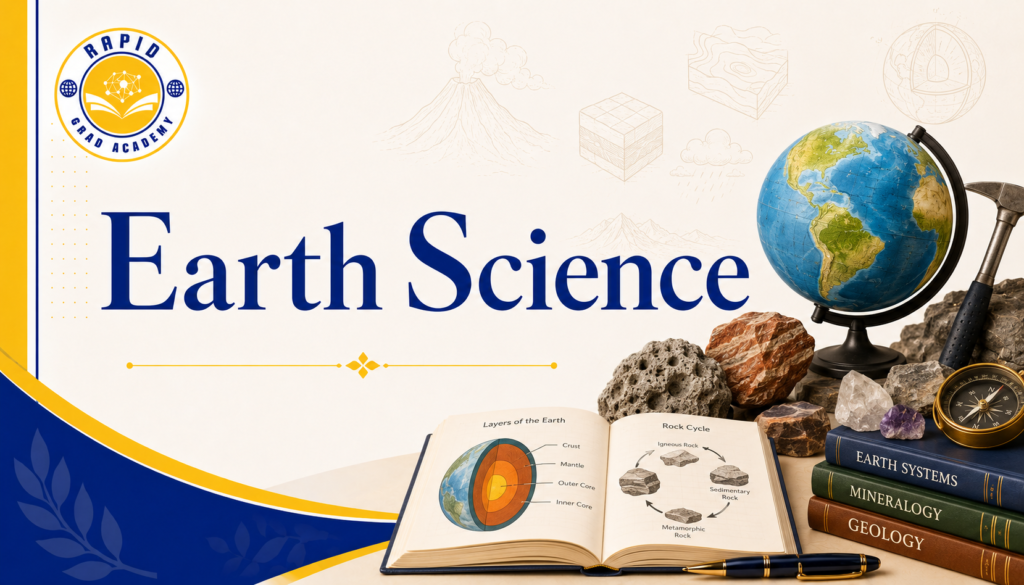
Earth Science is the study of a single object — the planet you are standing on — from four directions at once: its rocks, its water, its air, and its place in space.
This course treats Earth as a set of connected systems rather than a list of facts. You will learn why mountains form where they do, why some volcanoes erupt gently and others catastrophically, how a rock records the conditions it formed in, and how scientists reconstruct a climate from ice that fell as snow 800,000 years ago.
What you will study
- Unit 1 — Studying the Earth: scientific inquiry, Earth’s four spheres, maps and topography, and reading scientific data critically.
- Unit 2 — Earth’s Materials: minerals and their properties, the three rock families, and the rock cycle.
- Unit 3 — The Dynamic Earth: Earth’s interior, plate tectonics, earthquakes and volcanoes.
- Unit 4 — Surface Processes and Geologic Time: weathering, erosion, groundwater, and dating the rock record.
- Unit 5 — The Atmosphere and Oceans: weather systems, climate and climate change, ocean currents and tides.
- Unit 6 — Earth in Space and Human Impact: seasons and eclipses, the solar system, stars and the universe, and resources and sustainability.
How the course works
Most of your time is spent on teaching lessons with worked explanations and real examples. Each unit includes two interactive activities you complete on screen — typing answers directly into the worksheet, with nothing to print or upload — and one unit quiz marked automatically. A mid-course assessment follows Unit 3 and a final assessment closes the course.
What you will be able to do
By the end you will be able to explain the processes shaping the planet, read scientific data with confidence, and evaluate environmental claims on evidence rather than assertion.
Course Content
Getting Started
-
Course Overview and Learning Objectives
Unit 1: Studying the Earth
Unit 2: Earth’s Materials
Unit 3: The Dynamic Earth
Unit 4: Surface Processes and Geologic Time
Unit 5: The Atmosphere and Oceans
Unit 6: Earth in Space and Human Impact
Course Completion
Tags
Instructors


No Review Yet