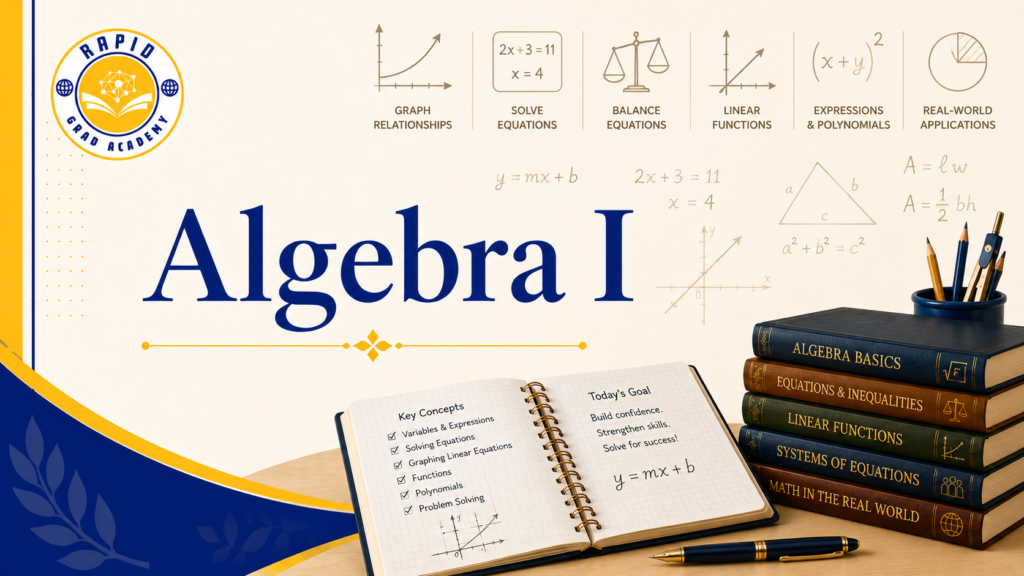

Algebra I

The gateway course to all higher mathematics: expressions, equations, inequalities, functions, systems and quadratics.

0.0
(0)
2 Enrolled

About Course

Algebra I is the gateway to every mathematics course that follows. It takes
you from working with numbers to working with relationships — expressions, equations and
functions that model real situations.

This course is built on understanding rather than memorisation. Every rule is explained before
it is used, every method is shown worked through in full, and the errors students actually make
are named and addressed directly rather than left to be discovered in a test.

What you will study

  • Unit 1 — The Language of Algebra: variables and expressions, order of
    operations, properties of real numbers, combining like terms.
  • Unit 2 — Linear Equations: one-step through multi-step equations, variables on
    both sides, rearranging formulas, and modelling word problems.
  • Unit 3 — Inequalities: solving and graphing, the sign-flip rule, compound
    inequalities, and absolute value.
  • Unit 4 — Functions and Graphing: relations and functions, domain and range,
    slope as a rate of change, the three forms of a linear equation, and graphing.
  • Unit 5 — Systems of Equations: solving by graphing, substitution and
    elimination, and applying systems to real problems.
  • Unit 6 — Exponents, Polynomials and Quadratics: exponent laws, scientific
    notation, polynomial operations, factoring, and solving quadratic equations.

How the course works

Most of your time is spent on teaching lessons containing full worked examples. Each unit
includes two interactive activities you complete on screen — typing answers directly into the
worksheet, with no printing or uploading — and one unit quiz that is marked automatically. A
mid-course assessment follows Unit 3 and a final assessment closes the course.

What you will be able to do

By the end you will be able to take a real situation, model it with an equation or a function,
solve it, graph it, and explain what the answer means — the foundation every later mathematics and
science course assumes you already have.

Show More

What Will You Learn?

  • Translate real situations into algebraic expressions and equations
  • Solve linear equations, inequalities and systems confidently
  • Interpret slope as a rate of change and graph any linear function
  • Apply the laws of exponents and operate on polynomials
  • Factor expressions and solve quadratic equations two different ways

Requirements

  • Confidence with arithmetic, negative numbers and fractions. No prior algebra required.

Audience

  • Students beginning their high school mathematics sequence, and learners who want to build genuine confidence with algebra rather than memorising procedures.

Course Content

Getting Started
<p>How this course works, what you will learn, and how you are assessed.</p>

  • Course Overview and Learning Objectives
    00:00

Unit 1: The Language of Algebra
<h2>Unit Introduction</h2> <p>Arithmetic asks <em>what is the answer</em>. Algebra asks <em>what is the relationship</em>.</p> <p>That shift is the whole subject. In arithmetic, 7 + 5 has one answer and you find it. In algebra, x + 5 describes a whole family of situations at once, and the letter stands for whichever number the situation happens to contain. Learning to read and write in that language is the work of this unit.</p> <p>Everything later in the course — equations, functions, graphs, quadratics — is built on these four lessons. Students who struggle with Algebra II almost always have a gap here rather than there.</p> <h2>Unit Learning Objectives</h2> <p>By the end of Unit 1 you will be able to: - Translate between word descriptions and algebraic expressions - Evaluate expressions using the correct order of operations - Identify and apply the commutative, associative, distributive and identity properties - Simplify expressions by combining like terms and distributing</p>

Unit 2: Linear Equations
<h2>Unit Introduction</h2> <p>An expression describes a quantity. An <strong>equation</strong> makes a claim: that two expressions have the same value. Solving an equation means finding every value of the variable that makes the claim true.</p> <p>There is one idea underneath every technique in this unit: <strong>whatever you do to one side, do to the other.</strong> An equation is a balance. Keep it balanced and the truth of the statement is preserved; break the balance and you have changed the problem.</p> <h2>Unit Learning Objectives</h2> <p>By the end of Unit 2 you will be able to: - Solve one-step, two-step and multi-step linear equations - Solve equations with variables on both sides - Rearrange formulas to make a given variable the subject - Translate real situations into equations and solve them</p>

Unit 3: Inequalities
<h2>Unit Introduction</h2> <p>An equation says two quantities are equal. An <strong>inequality</strong> says one is larger, smaller, or no more than the other — and that is a far more common situation in real life. A budget is an inequality. A speed limit is an inequality. A minimum grade requirement is an inequality.</p> <p>The solving techniques are almost identical to Unit 2, with <strong>one new rule</strong> that matters enormously and is forgotten constantly.</p> <h2>Unit Learning Objectives</h2> <p>By the end of Unit 3 you will be able to: - Solve and graph linear inequalities on a number line - Apply the sign-flip rule when multiplying or dividing by a negative - Solve compound inequalities joined by <em>and</em> or <em>or</em> - Solve absolute value equations and inequalities</p>

Unit 4: Functions and Graphing
<h2>Unit Introduction</h2> <p>So far algebra has been about finding <em>the</em> answer. This unit changes the question. A <strong>function</strong> does not have one answer — it has a rule that produces an output for every input you feed it.</p> <p>This is the most important conceptual step in Algebra I. Functions are how mathematics describes relationships: how cost depends on quantity, how distance depends on time, how population depends on year. Graphs let you see those relationships whole, instead of one number at a time.</p> <h2>Unit Learning Objectives</h2> <p>By the end of Unit 4 you will be able to: - Determine whether a relation is a function, and state domain and range - Calculate and interpret slope as a rate of change - Convert between slope-intercept, point-slope and standard form - Graph a linear function from any of those forms</p>

Unit 5: Systems of Equations
<h2>Unit Introduction</h2> <p>One equation describes one condition. Real problems usually impose several at once: a budget <em>and</em> a quantity limit, a total cost <em>and</em> a total weight.</p> <p>A <strong>system of equations</strong> is two or more equations that must be satisfied together. Its solution is the point that works in every equation — on a graph, the point where the lines cross.</p> <p>This unit gives you three methods and, just as importantly, teaches you to choose between them.</p> <h2>Unit Learning Objectives</h2> <p>By the end of Unit 5 you will be able to: - Solve a system by graphing and interpret the intersection - Solve a system by substitution - Solve a system by elimination - Choose the most efficient method and apply systems to real problems</p>

Unit 6: Exponents, Polynomials and Quadratics
<h2>Unit Introduction</h2> <p>Every relationship so far has been linear — constant rate, straight line. This unit introduces change that accelerates: quantities that double, areas that grow with the square of a side, objects that fall faster the longer they fall.</p> <p>The mathematics of curved change starts with exponents, builds through polynomials, and arrives at the quadratic equation — the second most important equation in school mathematics after the linear one.</p> <h2>Unit Learning Objectives</h2> <p>By the end of Unit 6 you will be able to: - Apply the laws of exponents, including zero and negative exponents - Add, subtract and multiply polynomials - Factor common polynomial forms - Solve quadratic equations by factoring and by the quadratic formula</p>

Course Completion
<p>Final assessment and full-course review.</p>

Instructors

Rapid Grad Academy

Rapid Grad Academy

4.3
90 Students
35 Courses
No Review Yet
No Review Yet