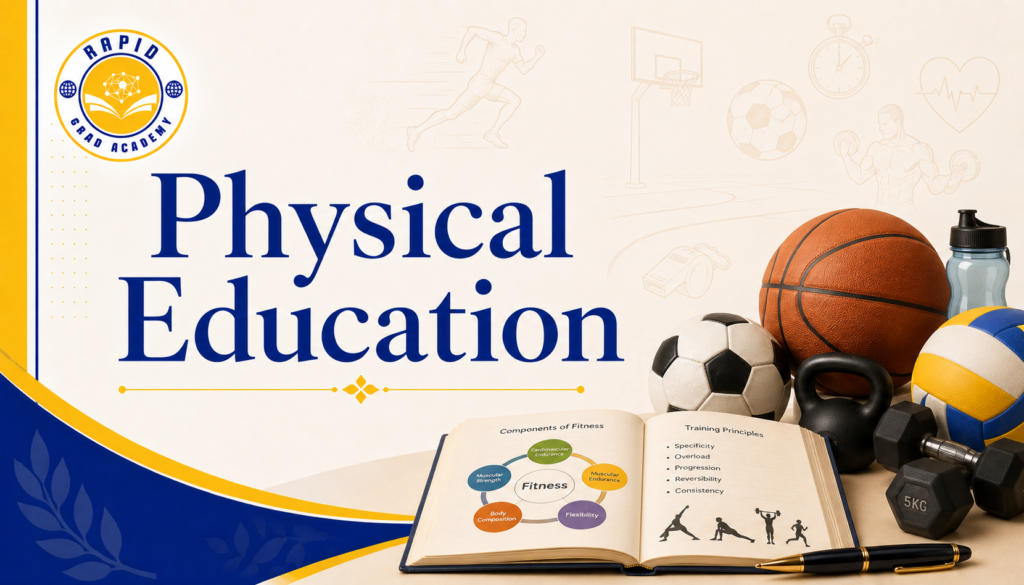

Physical Education

How the body adapts to training, how skills are learned, and how to build activity that lasts beyond school.

0.0
(0)
3 Enrolled

About Course

Physical Education is often taught as a series of activities to complete. This
course treats it as a subject with content: how the body adapts to training, why particular methods
work, how skills are actually learned, and how to design activity that fits your own life.

That matters because school ends. The people who remain active as adults are generally not the ones
who were best at school sport — they are the ones who understood what they were doing and found
something they wanted to keep doing.

What you will study

  • Unit 1 — Fitness Foundations: components of fitness, training principles, warm-up
    and cool-down, safety and injury response.
  • Unit 2 — Cardiovascular Fitness: the heart and lungs, energy systems, measuring
    intensity, and endurance training methods.
  • Unit 3 — Strength, Flexibility and Movement: how muscles work, safe resistance
    training, mobility, posture and movement quality.
  • Unit 4 — Skill Development: classifying skills, stages of learning, designing
    practice, and using feedback.
  • Unit 5 — Games, Tactics and Teamwork: game categories, tactical principles,
    communication and fair play.
  • Unit 6 — Lifelong Activity: motivation, barriers, programme design and staying
    active beyond school.

How the course works

Most of your time is spent on teaching lessons. Each unit includes two interactive activities you
complete on screen — programme design, analysing practice, diagnosing movement — and one unit quiz
marked automatically. A mid-course assessment follows Unit 3 and a final assessment closes the
course.

A note on the approach

This course focuses on performance, skill and health rather than body size or appearance. It sets
no body-composition targets and treats the components of fitness that respond directly to training as
the ones worth working on.

Consult a qualified healthcare professional before beginning any new physical activity
programme, particularly if you have a health condition or are returning after injury.

Show More

What Will You Learn?

  • Explain how the body responds and adapts to training
  • Design and progress a personal activity programme
  • Apply the principles of skill learning and effective practice
  • Understand tactical principles shared across games
  • Build activity that continues beyond school

Requirements

  • No prior experience or fitness level required. Activities can be adapted for different abilities and equipment availability.

Audience

  • All students completing their physical education requirement, at any current level of fitness or athletic experience.

Course Content

Getting Started
<p>How this course works, what you will learn, and how you are assessed.</p>

  • Course Overview and Learning Objectives

Unit 1: Fitness Foundations
<h2>Unit Introduction</h2> <p>Physical Education is frequently taught as a series of activities to complete. This course treats it as a subject with content: how the body adapts to training, why particular methods work, and how to design activity that fits your own life.</p> <p>That matters because school ends. The people who stay active as adults are not generally the ones who were best at school sport — they are the ones who understood what they were doing and found something they wanted to keep doing.</p> <h2>Unit Learning Objectives</h2> <p>By the end of Unit 1 you will be able to: - Identify the health-related and skill-related components of fitness - Apply the principles of training to explain how the body adapts - Explain the purpose of warm-up and cool-down and perform each correctly - Apply safety practices and recognise when to stop</p>

Unit 2: Cardiovascular Fitness
<h2>Unit Introduction</h2> <p>Cardiovascular fitness is the component with the strongest links to long-term health. It is also the one that responds most reliably to training — improvements are measurable within weeks in almost everyone.</p> <p>This unit covers what the heart and lungs actually do during exercise, how the body produces energy at different intensities, how to measure and control how hard you are working, and how to build endurance methodically.</p> <h2>Unit Learning Objectives</h2> <p>By the end of Unit 2 you will be able to: - Describe how the cardiovascular and respiratory systems respond to exercise - Distinguish aerobic from anaerobic energy production - Measure and use exercise intensity - Apply methods of endurance training</p>

Unit 3: Strength, Flexibility and Movement
<h2>Unit Introduction</h2> <p>Strength training is frequently misunderstood by people of school age — assumed to be about appearance, assumed to be unsuitable for young people, or assumed to require a gym.</p> <p>None of those is accurate. <strong>Appropriate resistance training is recommended for adolescents by every major health body</strong>, it improves bone density during the one period when that is most influenceable, it reduces injury risk in every sport, and much of it requires no equipment at all.</p> <p>This unit covers how muscles work, how to train them safely, and why flexibility and movement quality matter as much as force production.</p> <h2>Unit Learning Objectives</h2> <p>By the end of Unit 3 you will be able to: - Describe how muscles produce movement, including antagonistic pairs - Explain how to train muscular strength and endurance safely - Distinguish types of flexibility training and apply them appropriately - Explain posture, movement quality and their effect on performance and injury</p>

Unit 4: Skill Development and Motor Learning
<h2>Unit Introduction</h2> <p>Everyone has watched someone practise something for hours and improve very little, and watched someone else improve rapidly. The difference is rarely talent alone. It is usually <strong>how</strong> they practised.</p> <p>Motor learning is a well-studied field, and much of what it has established runs against intuition: practice that feels harder and produces worse results in the session often produces better retention; practice that feels smooth and successful often produces performance that collapses under pressure.</p> <p>This unit covers how skills are actually acquired, and how to practise so that improvement lasts.</p> <h2>Unit Learning Objectives</h2> <p>By the end of Unit 4 you will be able to: - Classify skills using the standard continua - Describe the stages of learning and what each requires - Design effective practice, including massed, distributed, variable and random practice - Use feedback and goal setting to accelerate learning</p>

Unit 5: Games, Tactics and Teamwork
<h2>Unit Introduction</h2> <p>Games look enormously varied — football, tennis, cricket, netball, badminton, hockey. Underneath, they fall into a small number of categories, and games within a category share tactical principles.</p> <p>Recognising that is genuinely useful. Someone who understands the tactical logic of invasion games picks up an unfamiliar invasion game quickly, because the underlying problems are the same: create space, deny space, transition quickly.</p> <p>This unit covers those categories, the tactical principles behind them, and the teamwork and conduct that determine whether a team performs above or below the sum of its players.</p> <h2>Unit Learning Objectives</h2> <p>By the end of Unit 5 you will be able to: - Classify games and identify shared tactical principles - Apply attacking and defending principles - Describe team roles, communication and cohesion - Explain fair play, officiating and sportsmanship</p>

Unit 6: Lifelong Activity
<h2>Unit Introduction</h2> <p>Most people are less active as adults than they were at school, and activity levels fall most sharply in the years immediately after leaving education. The structures that produced activity — timetabled lessons, school teams, facilities on site, friends doing the same thing — disappear all at once.</p> <p>This final unit is about what replaces them. It covers why people start and stop, what actually sustains activity over years rather than weeks, and how to design a programme that fits your own circumstances rather than an ideal you do not have.</p> <h2>Unit Learning Objectives</h2> <p>By the end of Unit 6 you will be able to: - Explain motivation and why some forms sustain activity better than others - Identify barriers to activity and realistic strategies for each - Design a personal activity programme - Describe recovery, activity nutrition and long-term participation</p>

Course Completion
<p>Final assessment and full-course review.</p>

Instructors

Rapid Grad Academy

Rapid Grad Academy

4.3
7 Students
25 Courses
No Review Yet
No Review Yet