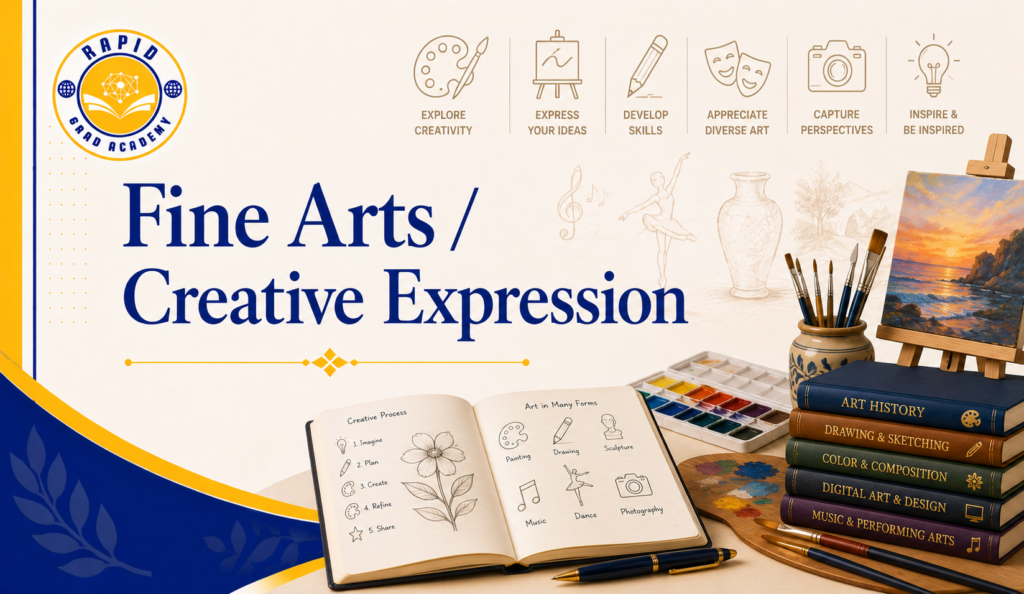
Fine Arts and Creative Expression

Visual art, music, drama, writing, photography, film and design — how to make work, how to look at it, and how to share it responsibly.
0.0
(0)
1 Enrolled

About Course

Fine Arts and Creative Expression covers how creative work is made across visual art,
music, drama and movement, creative writing, photography, film and design — and how to look at, discuss and
share it responsibly.

The course is built on one idea: creative ability develops through practice. Every unit
combines teaching with making, using materials most students already have.

What you will study

  • Unit 1 — The Creative Process: generating and developing ideas, and building a
    practice that lasts.
  • Unit 2 — Visual Art: elements and principles, drawing from observation, colour,
    composition, and media used safely. The longest unit, because the other forms borrow its vocabulary.
  • Unit 3 — Music: the elements of music, active listening, making music, and music
    across cultures.
  • Unit 4 — Drama and Movement: voice, body and intention, improvisation and devising,
    movement and staging.
  • Unit 5 — Writing, Photography, Film and Design: creative writing, lens-based media and
    the moving image, and design.
  • Unit 6 — Art in Context, Originality and Critique: looking at art, traditions across
    the world, copyright and AI, critique, portfolios and creative careers.

How the course works

Each unit includes teaching lessons, interactive activities you complete on screen alongside your own
practical work, and a unit quiz marked automatically. A mid-course assessment follows Unit 3 and a final
assessment closes the course.

A note on materials, safety and ownership

No specialist equipment is needed. The course includes guidance on using art materials safely, warming
up for physical and vocal work, and photographing or filming other people only with their consent.
Examples throughout are original to the course or drawn from public-domain works, and Unit 6 explains how
copyright, licences and AI-generated work apply to what students make and share.

Show More

What Will You Learn?

  • Use the creative process to generate, develop and refine original work
  • Draw from observation and use colour and composition deliberately
  • Listen actively, describe music precisely and create simple musical ideas
  • Build a character, devise a scene, and use movement safely
  • Write, photograph, film and design with purpose, and understand creative ownership

Requirements

  • None. A pencil, paper and a phone are enough to begin; no prior training in any art form is required.

Audience

  • All students, whether they consider themselves creative or not, and anyone preparing a portfolio for a creative course or career.

Course Content

Getting Started
<p>How this course works, what you will learn, and how you are assessed.</p>

  • Course Overview and Learning Objectives

Unit 1: The Creative Process
<h2>Unit Introduction</h2> <p><strong>Most people believe creativity is a talent you either have or do not.</strong> The evidence points elsewhere. <strong>Creative ability develops through practice, like any other skill</strong> — and the people who produce good work are overwhelmingly the people who produce a lot of work.</p> <p><strong>This unit covers the process underneath every art form in the course.</strong> Visual art, music, performance, writing and digital media all follow a recognisably similar cycle: generating ideas, developing them, refining, and sharing. <strong>Learning the cycle once makes every later unit easier.</strong></p> <p><em>This course involves making work at home. You do not need expensive equipment — a pencil, paper and a phone are enough to begin. Unit 2 includes guidance on materials and safety.</em></p> <h2>Unit Learning Objectives</h2> <p>By the end of Unit 1 you will be able to:</p> <ul> <li>Explain what creative expression is and why it matters</li> <li>Describe and apply the stages of the creative process</li> <li>Build habits that sustain creative practice</li> </ul>

Unit 2: Visual Art
<h2>Unit Introduction</h2> <p><strong>Visual art has the most developed vocabulary of any art form</strong> — and much of it is borrowed by the others. Photographers talk about composition, film-makers about colour, designers about balance, and musicians about texture and contrast.</p> <p><strong>This unit is the longest in the course for that reason.</strong> It covers the elements and principles that describe any visual work, how to draw from observation, how colour works, how to compose an image, and how to choose and use media safely.</p> <p><strong>Drawing from observation is the core skill.</strong> It is not about talent: <strong>it is about learning to see what is actually in front of you rather than what you assume is there</strong> — and that can be taught.</p> <h2>Unit Learning Objectives</h2> <p>By the end of Unit 2 you will be able to:</p> <ul> <li>Identify and use the elements of art and principles of design</li> <li>Draw from observation using measurement and value</li> <li>Explain colour systems and use colour deliberately</li> <li>Compose an image and choose appropriate media, used safely</li> </ul>

Unit 3: Music
<h2>Unit Introduction</h2> <p><strong>Music is the art form most people engage with every day and understand least technically.</strong> Almost everyone can tell when a piece feels happy, tense or finished — <strong>few can say why.</strong></p> <p><strong>This unit gives you the vocabulary to say why</strong>, a method for listening actively, and practical ways to start making music with little or no equipment.</p> <p><strong>No instrument or prior training is needed.</strong> Your voice, a phone and free software are enough.</p> <p><em>This unit discusses music by name and describes how it works. It does not reproduce lyrics or scores of copyrighted works; examples use ideas you can test yourself.</em></p> <h2>Unit Learning Objectives</h2> <p>By the end of Unit 3 you will be able to:</p> <ul> <li>Identify and describe the elements of music</li> <li>Listen actively and describe what you hear precisely</li> <li>Create simple musical ideas using voice or digital tools</li> <li>Describe music's roles across cultures and periods</li> </ul>

Unit 4: Drama and Movement
<h2>Unit Introduction</h2> <p><strong>Drama and movement use the one instrument everyone already has: the body.</strong> Voice, posture, gesture, stillness and the space between people all communicate before a word is spoken.</p> <p><strong>This unit covers the practical foundations</strong> — how actors build a character, how improvisation and devising create new work, how movement communicates, and how a short scene is rehearsed and staged. <strong>It is designed to work at home</strong>, alone or with one or two others, and online.</p> <p><strong>Performance involves physical activity.</strong> The lessons include warm-ups and safety guidance, and <strong>nothing in this unit should be attempted in a way that risks injury.</strong></p> <h2>Unit Learning Objectives</h2> <p>By the end of Unit 4 you will be able to:</p> <ul> <li>Use voice, body and intention to create a character</li> <li>Improvise and devise original performance material</li> <li>Describe and use movement expressively and safely</li> <li>Rehearse and stage a short scene</li> </ul>

Unit 5: Writing, Photography, Film and Design
<h2>Unit Introduction</h2> <p><strong>This unit covers three more forms of creative expression</strong>, each built on skills from earlier units.</p> <p><strong>Creative writing</strong> uses the precision and imagery from the English courses for your own work rather than analysis. <strong>Photography and film</strong> apply the composition from Unit 2 to a lens, and add time. <strong>Design</strong> combines image and text to communicate — and it is the creative field in which the largest number of people work professionally.</p> <p><strong>All three can be done with a phone and free software.</strong></p> <h2>Unit Learning Objectives</h2> <p>By the end of Unit 5 you will be able to:</p> <ul> <li>Write poetry and short fiction using deliberate technique</li> <li>Take and edit photographs, and plan and shoot a short film</li> <li>Apply design principles and typography to communicate clearly</li> <li>Photograph and film people ethically and safely</li> </ul>

Unit 6: Art in Context, Originality and Critique
<h2>Unit Introduction</h2> <p><strong>Making art is half of this course. Understanding it is the other half.</strong></p> <p>This unit covers how to look at any work carefully, how art has developed across cultures, the questions of ownership and originality that every maker now faces — <strong>including those raised by AI image and music generation</strong> — and how to give critique, build a portfolio, and think about creative work as a career.</p> <p><strong>Several questions in this unit are genuinely contested</strong>, among artists, courts and the public. Where that is the case, the course presents the competing positions rather than choosing one.</p> <h2>Unit Learning Objectives</h2> <p>By the end of Unit 6 you will be able to:</p> <ul> <li>Analyse any artwork using a structured method</li> <li>Describe connections across the world's artistic traditions</li> <li>Apply the rules and ethics of ownership, including for AI-generated work</li> <li>Give useful critique, build a portfolio, and describe creative career pathways</li> </ul>

Course Completion
<p>Final assessment and full-course review.</p>

Instructors

Rapid Grad Academy

Rapid Grad Academy

4.3
90 Students
35 Courses
No Review Yet
No Review Yet