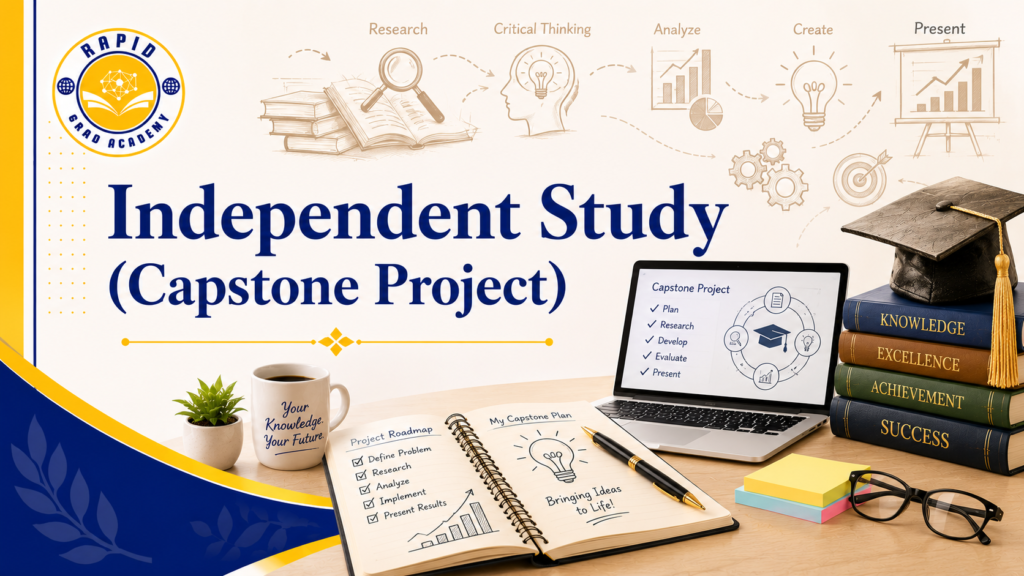

Independent Study(Capstone Project)

Choose a question, plan it, research it, produce it, and defend it — a months-long independent project with a mentor's guidance.
0.0
(0)
1 Enrolled

About Course

Independent Study and Capstone is a project course. Students choose a question or
problem, write a proposal, and carry it through research, production, presentation and defence over
several months, with an instructor’s guidance.

Four project types are available: a research investigation, an applied project, a community
project, or a creative work with critical commentary.
Each requires research, planning,
reflection and a final defence.

How this course is different

This course has fewer teaching lessons than other courses, because most of the time is the student’s
own project work. The interactive activities are the project milestones — the proposal,
the plan, the ethics review, the source log, the progress report, the defence preparation and the final
reflection — and each is reviewed by the instructor.

What you will study

  • Unit 1 — Choosing and Framing a Project: project types, finding a question, and the
    proposal.
  • Unit 2 — Planning and Managing the Work: backward planning, working independently,
    and using feedback.
  • Unit 3 — Research, Ethics and Evidence: background research, research ethics and
    safety, primary methods, and analysing evidence.
  • Unit 4 — Making and Producing: working in cycles, quality, and documenting the
    process.
  • Unit 5 — Presenting and Defending: the final report, the presentation, and the
    defence.
  • Unit 6 — Reflection and What Comes Next: honest evaluation, and using the capstone in
    applications.

Safety and approval

The project proposal must be approved before work begins. Any research involving other people,
any physical risk, and any sensitive topic requires specific instructor approval before that part of the
project starts.
Participants under 18 require parent or guardian consent. Students never meet
research contacts alone or privately.

Show More

What Will You Learn?

  • Choose and narrow a question worth answering
  • Plan and manage a months-long independent project
  • Conduct research ethically and safely, including with other people
  • Produce, present and defend a finished project
  • Evaluate your own work honestly and use it in applications

Requirements

  • Completion of Grade 11 or equivalent. Students need regular access to a mentor or instructor throughout the project.

Audience

  • Grade 12 students completing a capstone or independent study requirement, and anyone preparing for university-level independent work.

Course Content

Getting Started
<p>How this course works, what you will learn, and how you are assessed.</p>

  • Course Overview and Learning Objectives

Unit 1: Choosing and Framing a Project
<h2>Unit Introduction</h2> <p><strong>A capstone is the point where you stop being taught and start directing your own work.</strong></p> <p>Every earlier course gave you the question. <strong>This one asks you to find it</strong> — and then to plan, research, produce, present and defend an answer over several months, with a mentor's guidance but without a syllabus telling you what comes next.</p> <p><strong>The most important decision in the whole project is made in this unit.</strong> A well-chosen, well-framed question makes the next five units manageable. A vague or oversized one makes them miserable. <strong>Most capstones that go wrong were set up wrong.</strong></p> <p><strong>This unit ends with your project proposal</strong>, which your instructor must approve before you begin.</p> <h2>Unit Learning Objectives</h2> <p>By the end of Unit 1 you will be able to: - Describe the main types of capstone project and what each produces - Develop a focused, feasible question from a broad interest - Write a proposal covering question, scope, method, timeline, resources and risks</p>

Unit 2: Planning and Managing the Work
<h2>Unit Introduction</h2> <p><strong>An approved proposal is a destination. This unit builds the route</strong> — and the habits to keep travelling it when no one is checking every week.</p> <p><strong>Independent projects rarely fail because of one catastrophic problem.</strong> They fail through drift: weeks where a little less gets done than planned, until the gap is too large to close. <strong>The defences against drift are a realistic plan, a record of progress, and honest use of feedback.</strong></p> <h2>Unit Learning Objectives</h2> <p>By the end of Unit 2 you will be able to: - Build a backward-planned timeline with milestones and slack - Manage independent work, including when you are stuck - Seek, receive and act on feedback from a mentor</p>

Unit 3: Research, Ethics and Evidence
<h2>Unit Introduction</h2> <p><strong>Every capstone type needs research.</strong> An investigation is built on it; an applied project needs to know what exists and what users need; a community project needs to know what the community wants; a creative project needs to know its influences and context.</p> <p><strong>This unit also covers something earlier courses did not need to: research that involves other people.</strong> Surveys, interviews and observation raise ethical and safety questions, and <strong>any project collecting information from people requires approval before that collection begins.</strong></p> <h2>Unit Learning Objectives</h2> <p>By the end of Unit 3 you will be able to: - Conduct and document background research - Apply ethical and safety principles to research involving people - Choose and use appropriate primary research methods - Analyse evidence and state what it can and cannot show</p>

Unit 4: Making and Producing
<h2>Unit Introduction</h2> <p><strong>This is the longest stretch of the project in time, and the shortest in teaching.</strong> Most of it is you, working.</p> <p><strong>The unit covers three things that determine whether the production phase goes well:</strong> working in cycles rather than trying to get it right first time, checking quality against your own success criteria, and documenting the process as it happens — because the process is assessed, and it cannot be reconstructed accurately afterward.</p> <p><strong>This unit ends with a progress report</strong> to your instructor.</p> <h2>Unit Learning Objectives</h2> <p>By the end of Unit 4 you will be able to: - Work iteratively through drafts, prototypes and cycles - Check quality against success criteria as you go - Document the process in a way that supports assessment and reflection</p>

Unit 5: Presenting and Defending
<h2>Unit Introduction</h2> <p><strong>A project that cannot be explained cannot be assessed, used or valued.</strong></p> <p>This unit covers the three ways you will communicate your capstone: <strong>the final written report</strong>, which records what you did and found; <strong>the presentation</strong>, which explains it to an audience; and <strong>the defence</strong>, in which you answer questions about it.</p> <p><strong>The defence is the part students worry about most</strong>, and it is the part where a well-documented, honestly evaluated project performs best — because you will be asked about exactly the things your process record already covers.</p> <h2>Unit Learning Objectives</h2> <p>By the end of Unit 5 you will be able to: - Structure a final report appropriate to your project type - Plan and deliver a clear presentation - Prepare for and handle questions in a defence</p>

Unit 6: Reflection and What Comes Next
<h2>Unit Introduction</h2> <p><strong>The project is finished. This unit makes it useful.</strong></p> <p><strong>Honest reflection turns an experience into learning</strong> — identifying what you now know about how you work, what you would do differently, and what transfers to the next project.</p> <p><strong>The second lesson turns the capstone into something you can use</strong>: evidence in applications, interviews and portfolios, which is where a completed independent project is most valuable.</p> <h2>Unit Learning Objectives</h2> <p>By the end of Unit 6 you will be able to: - Evaluate your project honestly against its success criteria - Identify what you learned about your own working process - Present your capstone effectively in applications, interviews and portfolios</p>

Course Completion
<p>Final assessment and full-course review.</p>

Instructors

Rapid Grad Academy

Rapid Grad Academy

4.3
90 Students
35 Courses
No Review Yet
No Review Yet