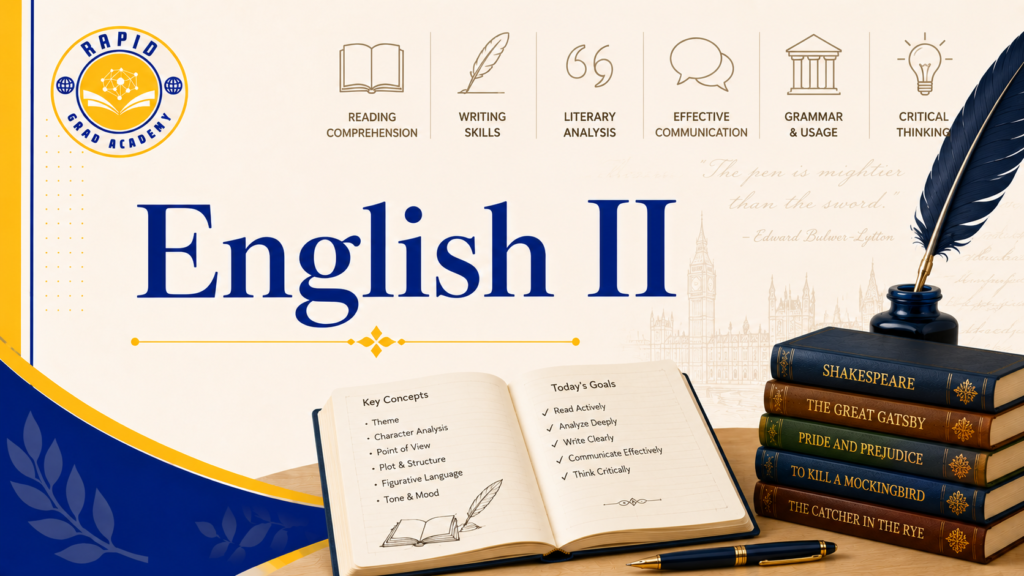
English II

World literature, rhetoric, argument and research: reading across cultures and writing arguments that survive scrutiny.
0.0
(0)
1 Enrolled

About Course

English II widens your reading from a single tradition to a global one, and moves
your writing from analysis into argument.

The course is built on a single idea: most misreading and most bad argument come from
assumptions you cannot see
— conventions you treat as universal, positions you have never
heard stated properly, evidence you accepted because it agreed with you. Every unit attacks that
problem from a different direction.

What you will study

  • Unit 1 — Reading Across Cultures: context, translation, and reading without
    supplying your own assumptions.
  • Unit 2 — Narrative Craft: structure beyond linear chronology, characterisation
    across traditions, perspective, and symbol and allegory.
  • Unit 3 — Rhetoric and Persuasion: the rhetorical situation, the three appeals,
    rhetorical devices, propaganda and media framing.
  • Unit 4 — The Argumentative Essay: claims and warrants, counterargument, structure,
    tone and logical fallacies.
  • Unit 5 — Research and Information Literacy: research questions, source evaluation,
    integration and citation.
  • Unit 6 — Drama, Poetry and Comparative Analysis: world drama, poetry in
    translation, and writing sustained comparison.

How the course works

Most of your time is spent on teaching lessons with worked examples and model analysis. Each unit
includes two interactive activities you complete on screen — source evaluation, argument construction,
comparative planning — and one unit quiz marked automatically. A mid-course assessment follows Unit 3
and a final assessment closes the course.

All literary examples are original or drawn from public-domain and openly available texts.

What you will be able to do

By the end you will be able to read a text from an unfamiliar tradition without misreading it
through your own conventions, take a position and defend it against its strongest opposition, find and
evaluate evidence rather than accepting what confirms you, and compare two texts in a way that says
something neither could say alone.

Show More

What Will You Learn?

  • Read literature from unfamiliar traditions without importing your own assumptions
  • Analyse how persuasion works, in literature and in the world
  • Construct arguments that address the strongest opposing case
  • Find, evaluate and integrate research sources responsibly
  • Write sustained comparative analysis

Requirements

  • English I or equivalent. Confident close reading and paragraph-level writing.

Audience

  • Students who have completed English I and are ready to move from comprehension into interpretation, argument and independent research.

Course Content

Getting Started
<p>How this course works, what you will learn, and how you are assessed.</p>

  • Course Overview and Learning Objectives

Unit 1: Reading Across Cultures
<h2>Unit Introduction</h2> <p>English I taught you to read closely: notice repetition and contrast, build inferences from evidence, state a theme as an arguable claim. Those tools still apply, and this unit adds something they did not require.</p> <p>When you read a text from your own culture, you supply an enormous amount without noticing — what a gesture means, why a character's silence is significant, what an occasion implies. <strong>Reading across cultures means reading without that automatic supply</strong>, and learning to notice when you are filling a gap with an assumption rather than with evidence.</p> <h2>Unit Learning Objectives</h2> <p>By the end of Unit 1 you will be able to: - Distinguish what a text states from what its original readers would have supplied - Explain how cultural and historical context shapes meaning - Describe how translation affects a text and what is at stake in translators' choices - Apply close reading to unfamiliar texts without defaulting to your own assumptions</p>

Unit 2: Narrative Craft
<h2>Unit Introduction</h2> <p>English I took fiction apart into its components. This unit examines how those components are handled differently across literary traditions — and what that variation reveals about the assumptions behind each.</p> <p>The most useful discovery in this unit is that <strong>the conventions you think of as how stories work are conventions</strong>, not requirements. Linear chronology, psychological interiority, individual protagonists and resolved endings are choices with histories, and other traditions make different ones.</p> <h2>Unit Learning Objectives</h2> <p>By the end of Unit 2 you will be able to: - Analyse narrative structures beyond linear chronology - Compare approaches to characterisation across traditions - Analyse perspective, including collective and unreliable narration - Distinguish symbol, allegory and parable, and analyse each</p>

Unit 3: Rhetoric and Persuasion
<h2>Unit Introduction</h2> <p>You are the target of persuasion constantly — advertising, political messaging, social media, journalism, and people you know. Most of it is designed by people who have studied how persuasion works.</p> <p><strong>Rhetoric is that study.</strong> It is not a synonym for empty talk, despite how the word is now commonly used. It is the systematic analysis of how language moves people, and it is around two and a half thousand years old.</p> <p>This unit teaches you to see the machinery. That serves two purposes: it makes you a more effective writer of argument, which Unit 4 requires, and it makes you considerably harder to manipulate.</p> <h2>Unit Learning Objectives</h2> <p>By the end of Unit 3 you will be able to: - Analyse the appeals and the rhetorical situation - Identify and explain the effect of major rhetorical devices - Analyse a speech or persuasive text systematically - Recognise propaganda techniques and evaluate media framing</p>

Unit 4: The Argumentative Essay
<h2>Unit Introduction</h2> <p>English I taught the analytical essay — an argument about a text. This unit teaches the argumentative essay, which is an argument about a question.</p> <p><strong>The difference matters.</strong> In analysis, your evidence is the text and your opponent is an alternative reading. In argument, your evidence comes from many sources and your opponent is a person who disagrees and has reasons. <strong>You have to take those reasons seriously</strong>, which is the part most students skip and the part examiners weight most heavily.</p> <h2>Unit Learning Objectives</h2> <p>By the end of Unit 4 you will be able to: - Construct an arguable thesis with reasons and evidence - Identify and address counterarguments fairly - Structure an argument effectively - Control tone, and identify logical fallacies in your own reasoning</p>

Unit 5: Research and Information Literacy
<h2>Unit Introduction</h2> <p>Unit 4 assumed you had evidence. This unit is about getting it, and about the harder problem of knowing whether what you have found is any good.</p> <p><strong>That problem has become significantly harder.</strong> The volume of available information is enormous, a great deal of it is produced to persuade rather than inform, search results are shaped by commercial interests, and content that looks authoritative is easy to generate. <strong>Evaluation matters more than retrieval now</strong>, which reverses the situation of a generation ago.</p> <h2>Unit Learning Objectives</h2> <p>By the end of Unit 5 you will be able to: - Develop a researchable question and an effective search strategy - Evaluate sources for credibility, bias and relevance - Integrate sources into your writing through quotation, paraphrase and summary - Cite correctly and avoid plagiarism</p>

Unit 6: Drama, Poetry and Comparative Analysis
<h2>Unit Introduction</h2> <p>This final unit brings the two strands of the course together. You will read drama and poetry from several traditions, applying the contextual reading of Units 1–2, and you will write comparative analysis, applying the argumentative structure of Units 3–4 with the research discipline of Unit 5.</p> <p><strong>Comparison is the most demanding form of literary writing</strong> because it requires holding two texts in mind simultaneously and saying something that neither text alone could support. It is also the most common form in advanced assessment, which makes it worth doing properly.</p> <h2>Unit Learning Objectives</h2> <p>By the end of Unit 6 you will be able to: - Analyse drama from different traditions, including non-realist conventions - Analyse poetry in translation with appropriate caution - Construct a genuine comparative argument - Write a sustained comparative essay</p>

Course Completion
<p>Final assessment and full-course review.</p>

Instructors

Rapid Grad Academy

Rapid Grad Academy

4.3
90 Students
35 Courses
No Review Yet
No Review Yet