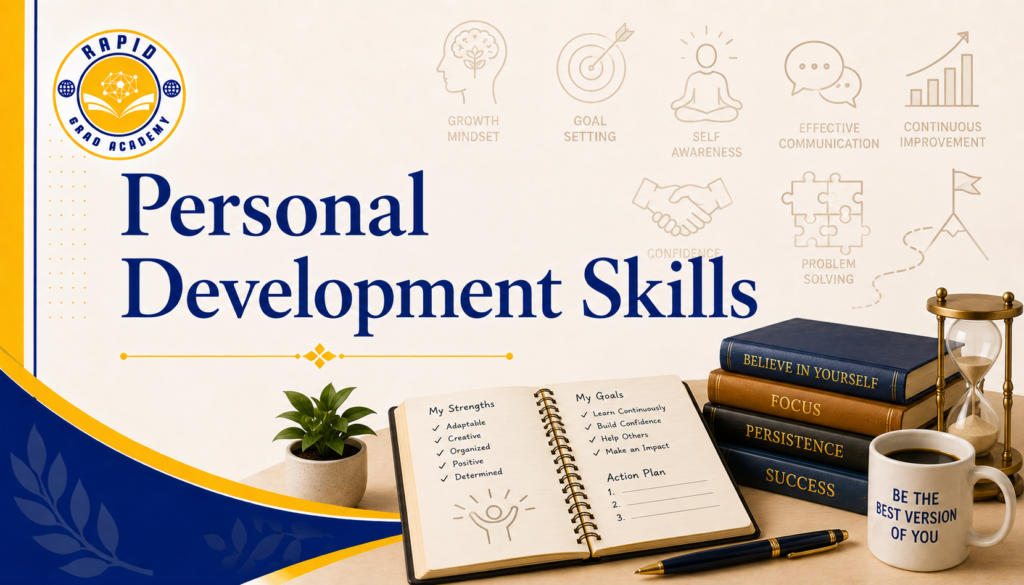

Personal Development Skills
Evidence-based skills for managing yourself: emotions, habits, setbacks, relationships and decisions.

About Course
Personal Development Skills covers the practical skills of managing yourself:
knowing what you are actually good at, working with your emotions rather than against them, building
habits that survive a bad week, recovering from setbacks, communicating clearly, and making decisions
you can defend.
The course is built on evidence, and it says so when the evidence is thin. Several widely repeated
ideas about self-improvement — learning styles, personality typing as measurement, the 21-day habit
claim, “what doesn’t kill you makes you stronger” — are not supported, and this course explains what
the research actually shows rather than repeating them.
What you will study
- Unit 1 — Self-Awareness and Identity: self-concept and self-efficacy, strengths and
development areas, mindset research and its limits, values and identity. - Unit 2 — Emotional Skills: what emotions do, regulation strategies that work and
those that do not, empathy, and getting support. - Unit 3 — Habits, Motivation and Self-Management: how habits form, why motivation is
unreliable, what procrastination actually is, and managing attention and time. - Unit 4 — Resilience and Setbacks: what resilience really depends on, coping
strategies, responding to failure and criticism, and building support. - Unit 5 — Relationships and Communication: assertiveness, boundaries, conflict and
repair, difficult people and online communication. - Unit 6 — Decisions, Integrity and Independence: decision-making and thinking
errors, ethical frameworks, critical thinking, and practical independent living.
How the course works
Most of your time is spent on teaching lessons with worked examples. Each unit includes two
interactive activities you complete on screen and one unit quiz marked automatically. A mid-course
assessment follows Unit 3 and a final assessment closes the course.
Activities are skills-based — analysing, planning, rewriting, mapping — and do not require you to
disclose personal information.
This course teaches skills and is not therapy or clinical treatment. Several units discuss
emotional difficulty and each directs you toward appropriate support. If anything in this course raises
a concern about your own wellbeing, speak to a healthcare professional or a trusted adult.
Course Content
Getting Started
-
Course Overview and Learning Objectives
Unit 1: Self-Awareness and Identity
Unit 2: Emotional Skills
Unit 3: Habits, Motivation and Self-Management
Unit 4: Resilience and Setbacks
Unit 5: Relationships and Communication
Unit 6: Decisions, Integrity and Independence
Course Completion
Tags
Instructors


No Review Yet