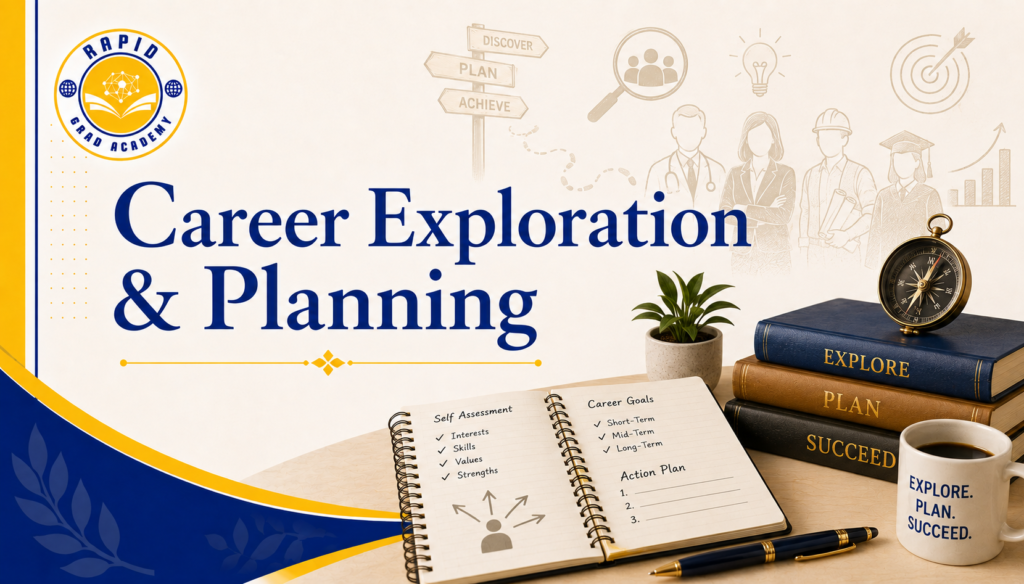

Career Exploration and Planning
How to work out what you might do, how to find out what it is actually like, and how to get there.

About Course
Career Exploration and Planning is a practical course about what happens after
school. It covers how to work out what might suit you, how to find out what work is actually like, what
the routes into it cost, and how to get hired and succeed once you are.
The course begins by dismantling the question you are most often asked. “What do you want to do?”
assumes careers are chosen once, that the choice should be obvious, and that not knowing means
something is wrong. None of that is accurate, and the pressure to produce an answer causes worse
decisions than admitting uncertainty does.
What you will study
- Unit 1 — Knowing Yourself and the World of Work: interests, skills, values and
working conditions; career clusters; how work is changing; and the myths worth correcting. - Unit 2 — Exploring Careers: researching occupations properly, evaluating sources,
informational interviews and work experience. - Unit 3 — Education and Training Pathways: degrees, apprenticeships, certificates
and licences; full costs and debt; choosing and applying. - Unit 4 — Employability Skills: communication, problem-solving, teamwork,
adaptability, professionalism and how to evidence them. - Unit 5 — Getting Hired: finding openings, résumés, cover letters, interviews and
networking. - Unit 6 — Succeeding and Planning Ahead: starting a role, workplace rights,
understanding pay and benefits, and managing a career over decades.
How the course works
Most of your time is spent on teaching lessons with worked examples. Each unit includes two
interactive activities you complete on screen — building a self-assessment, planning research, drafting
applications — and one unit quiz marked automatically. A mid-course assessment follows Unit 3 and a
final assessment closes the course.
This course is educational and does not constitute financial, legal or employment-law advice.
Employment law and education finance vary substantially by country and region; check the specific rules
where you live. For decisions involving significant borrowing, consult a qualified adviser.
Course Content
Getting Started
-
Course Overview and Learning Objectives
Unit 1: Knowing Yourself and the World of Work
Unit 2: Exploring Careers
Unit 3: Education and Training Pathways
Unit 4: Employability Skills
Unit 5: Getting Hired
Unit 6: Succeeding and Planning Ahead
Course Completion
Tags
Instructors


No Review Yet