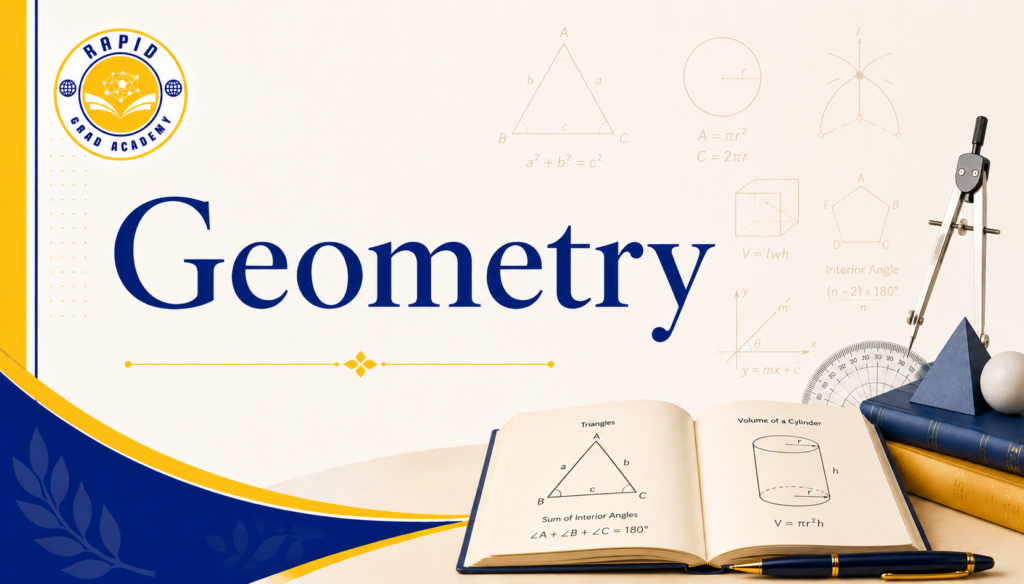
Geometry
Where mathematics stops calculating and starts proving: shape, space, measurement and the logic that establishes them.

About Course
Geometry shifts mathematics from calculation to reasoning. You will study shape,
space and measurement, but the deeper subject of the course is proof — learning how a
mathematical claim is established beyond doubt rather than merely checked.
This is the only place in school mathematics where you learn what a valid argument actually is: what
counts as a reason, why a converse does not follow from a conditional, and how a chain of justified
steps produces certainty. Those habits transfer far beyond mathematics.
What you will study
- Unit 1 — Foundations: undefined terms, segments and angles, angle pairs, and
compass-and-straightedge constructions. - Unit 2 — Reasoning and Proof: conditional statements, inductive and deductive
reasoning, two-column proofs, and parallel lines. - Unit 3 — Triangles: classification, angle relationships, the five congruence
criteria, isosceles triangles and inequalities. - Unit 4 — Similarity and Right Triangles: ratio and proportion, similarity
criteria, the Pythagorean Theorem, and right triangle trigonometry. - Unit 5 — Polygons and Circles: angle sums, special quadrilaterals, and circle
theorems involving chords, tangents, arcs and inscribed angles. - Unit 6 — Measurement and Transformations: area and volume, coordinate geometry,
and the transformations that define congruence and similarity.
How the course works
Most of your time is spent on teaching lessons containing full worked examples and complete proofs.
Each unit includes two interactive activities you complete on screen and one unit quiz marked
automatically. A mid-course assessment follows Unit 3 and a final assessment closes the course.
What you will be able to do
By the end you will be able to construct a valid argument from stated assumptions, measure what you
cannot reach, and recognise when a claim has been established rather than merely asserted.
Course Content
Getting Started
-
Course Overview and Learning Objectives
Unit 1: Foundations of Geometry
Unit 2: Reasoning and Proof
Unit 3: Triangles
Unit 4: Similarity and Right Triangles
Unit 5: Polygons, Quadrilaterals and Circles
Unit 6: Measurement, Coordinates and Transformations
Course Completion
Tags
Instructors


No Review Yet