Biology

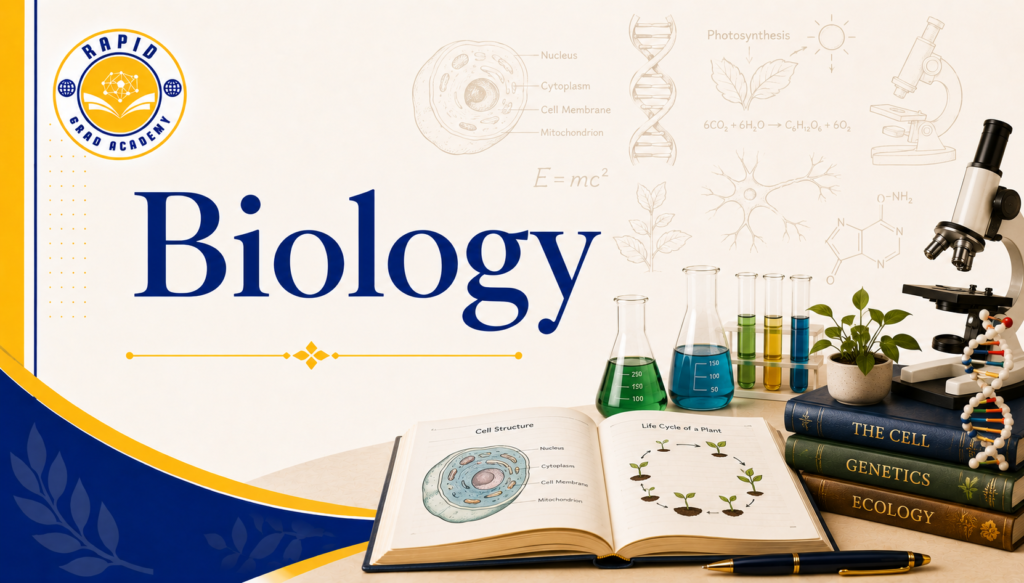
Life from molecules to ecosystems: how cells work, how information is inherited, and how every living thing came to be the way it is.
0.0
(0)
1 Enrolled

About Course

Biology studies life at every scale — from the molecules inside a single cell to
the ecosystems covering continents. This course connects those scales rather than treating them as
separate topics, because the connections are where biology actually becomes intelligible.

The organising principle is evidence. Where something is well established, the course says how we
know. Where a question is genuinely open — whether viruses are alive, where species boundaries fall —
it says so, because the disagreements are often more instructive than the settled answers.

What you will study

  • Unit 1 — The Study of Life: what distinguishes living things, how biological
    claims are tested, and the chemistry everything else depends on.
  • Unit 2 — Cells: cell theory, organelles as a working system, membranes and
    transport, and the cell cycle.
  • Unit 3 — Energy and Metabolism: ATP, photosynthesis, cellular respiration, and
    energy flow through ecosystems.
  • Unit 4 — Genetics and Heredity: DNA structure and replication, protein synthesis,
    meiosis, inheritance and genetic technology.
  • Unit 5 — Evolution and Classification: the evidence for evolution, natural
    selection, speciation, and how life is classified.
  • Unit 6 — Ecology and Human Impact: ecosystems, populations, succession, and what
    human activity is doing to them.

How the course works

Most of your time is spent on teaching lessons built around mechanisms and worked examples. Each
unit includes two interactive activities you complete on screen — analysing data, tracing pathways,
solving genetics problems — and one unit quiz marked automatically. A mid-course assessment follows
Unit 3 and a final assessment closes the course.

What you will be able to do

By the end you will understand how a cell works, how inheritance operates, and how the diversity of
life was produced — and you will be able to evaluate a biological claim rather than simply accepting
it.

Show More

What Will You Learn?

  • Explain how cells are structured and how they function
  • Describe how energy flows from sunlight through living systems
  • Explain how genetic information is stored, copied and expressed
  • Evaluate the evidence for evolution and explain natural selection
  • Analyse ecosystems and human impacts on them

Requirements

  • No prior biology required. Comfort with basic chemistry and with reading data is helpful.

Audience

  • Students completing their life science requirement, and anyone considering medicine, healthcare, environmental science, agriculture or research.

Course Content

Getting Started
<p>How this course works, what you will learn, and how you are assessed.</p>

  • Course Overview and Learning Objectives

Unit 1: The Study of Life
<h2>Unit Introduction</h2> <p>Biology asks a question that sounds simple and is not: <strong>what makes something alive?</strong></p> <p>A crystal grows. A fire consumes fuel, produces heat and spreads. A virus carries genetic instructions and reproduces. None of these is straightforwardly alive, and working out why requires being precise about what life involves.</p> <p>This unit establishes that definition, sets out how biological claims are tested, and covers the chemistry everything else depends on — because living things are chemical systems, and the properties of a few molecules explain a remarkable amount of what follows.</p> <h2>Unit Learning Objectives</h2> <p>By the end of Unit 1 you will be able to: - Identify the characteristics shared by all living things - Apply experimental design and evaluate biological evidence - Explain the properties of water that make life possible - Describe the four macromolecule groups and how enzymes work</p>

Unit 2: Cells
<h2>Unit Introduction</h2> <p>Every living thing is made of cells, and almost everything a living thing does is something its cells are doing.</p> <p><strong>The cell is where biology's levels meet.</strong> It is large enough to contain the chemistry of Unit 1 and small enough to be the unit that reproduces, responds and dies. Understanding the cell is what makes genetics, physiology and disease intelligible rather than a list of facts.</p> <h2>Unit Learning Objectives</h2> <p>By the end of Unit 2 you will be able to: - State cell theory and describe how it was established - Identify organelles and their functions - Explain membrane structure and the mechanisms of transport - Describe the cell cycle, mitosis and what happens when control fails</p>

Unit 3: Energy and Metabolism
<h2>Unit Introduction</h2> <p>Everything a cell does requires energy, and cells cannot use sunlight or food directly. <strong>Both must be converted into a form the cell can spend</strong>, and that form is ATP.</p> <p>This unit follows energy from the Sun into a plant, from the plant into an animal, and out again as heat. <strong>Photosynthesis and cellular respiration are close to reverse processes</strong>, and together they form the cycle on which almost all life depends.</p> <h2>Unit Learning Objectives</h2> <p>By the end of Unit 3 you will be able to: - Explain the role of ATP as the cell's energy currency - Describe photosynthesis and the factors affecting its rate - Describe cellular respiration, including anaerobic pathways - Explain how energy flows through ecosystems</p>

Unit 4: Genetics and Heredity
<h2>Unit Introduction</h2> <p>For most of human history, heredity was a mystery. Children resembled parents, and nobody could say how or why.</p> <p><strong>The answer turned out to be a molecule.</strong> DNA stores instructions in a four-letter code, copies itself with extraordinary accuracy, and directs the construction of every protein in your body. The same molecule and the same code operate in bacteria, oak trees and whales.</p> <p>This unit covers how that works — and how it sometimes does not, which is where genetic disease and variation come from.</p> <h2>Unit Learning Objectives</h2> <p>By the end of Unit 4 you will be able to: - Describe DNA structure and replication - Explain transcription and translation - Describe meiosis and explain how it produces variation - Solve inheritance problems and describe modern genetic technology</p>

Unit 5: Evolution and Classification
<h2>Unit Introduction</h2> <p>Evolution is the organising theory of biology. Without it, biology is a catalogue of unconnected facts; with it, those facts become a single history.</p> <p><strong>This unit examines the evidence.</strong> That emphasis is deliberate — evolution is frequently discussed as a belief, and it is not one. It is a conclusion supported by converging evidence from fossils, anatomy, embryology, biogeography, direct observation and, most decisively, molecular genetics.</p> <h2>Unit Learning Objectives</h2> <p>By the end of Unit 5 you will be able to: - Describe the lines of evidence for evolution - Explain natural selection and the conditions it requires - Describe speciation and patterns of evolutionary change - Explain classification and read a phylogenetic tree</p>

Unit 6: Ecology and Human Impact
<h2>Unit Introduction</h2> <p>Ecology studies how organisms interact with each other and with their environment. It is the level of biology where everything in this course comes together — cells, energy, genetics and evolution all operating within systems large enough to include weather, geology and, now, human activity.</p> <p><strong>It is also where biology becomes unavoidably practical.</strong> Decisions about land, water, food and climate are ecological decisions, and understanding the science is a precondition for evaluating the arguments about them.</p> <h2>Unit Learning Objectives</h2> <p>By the end of Unit 6 you will be able to: - Describe ecosystem structure and species interactions - Explain population growth and limiting factors - Describe succession and ecosystem change - Analyse human impacts and conservation approaches</p>

Course Completion
<p>Final assessment and full-course review.</p>

Instructors

Rapid Grad Academy

Rapid Grad Academy

4.3
90 Students
35 Courses
No Review Yet
No Review Yet