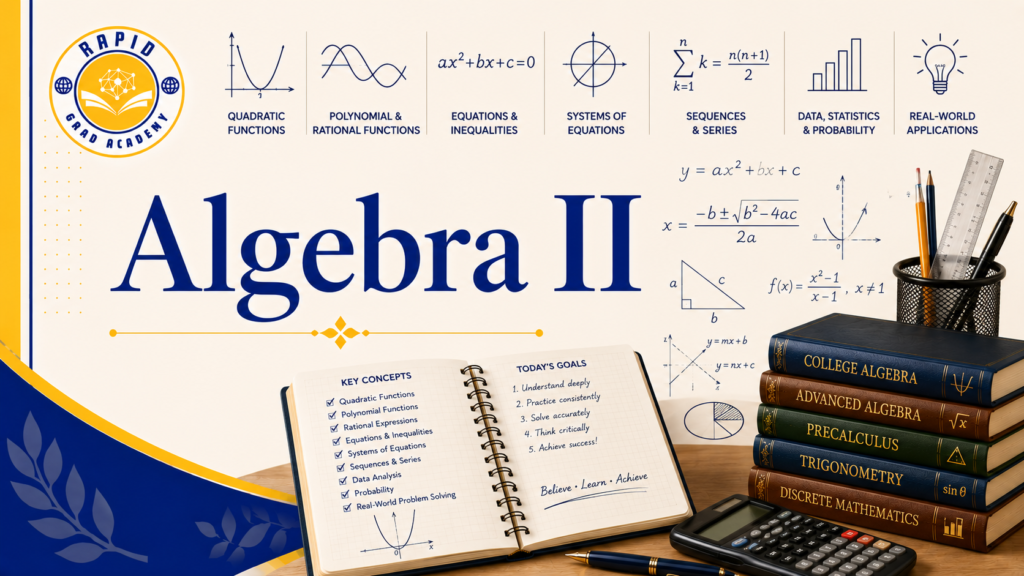

Algebra II

Functions of every kind — quadratic, polynomial, rational, exponential and logarithmic — with the algebra needed to work with them.

0.0
(0)
1 Enrolled

About Course

Algebra II takes the single function family of Algebra I and extends it in every
direction: quadratic, polynomial, rational, radical, exponential and logarithmic. Each behaves
differently, and each requires its own techniques.

The course is built around worked examples. Every method is demonstrated in full, including the steps
that are usually skipped, and the errors that cost the most marks are named explicitly rather than left
to be discovered in an assessment.

What you will study

  • Unit 1 — Foundations: real numbers and properties, linear equations and
    inequalities, compound inequalities and absolute value.
  • Unit 2 — Functions and Systems: function notation, domain and range,
    transformations, inverses, and systems in two and three variables.
  • Unit 3 — Quadratics and Complex Numbers: graphing, four solution methods, the
    discriminant, complex arithmetic and quadratic inequalities.
  • Unit 4 — Polynomial and Rational Functions: division, the Remainder and Factor
    Theorems, the Rational Root Theorem, multiplicity, rational expressions and asymptotes.
  • Unit 5 — Exponential, Logarithmic and Radical Functions: rational exponents, radical
    equations, growth and decay, logarithm properties and solving.
  • Unit 6 — Sequences, Series, Probability and Statistics: arithmetic and geometric
    patterns, counting, probability and interpreting data.

How the course works

Most of your time is spent on teaching lessons with fully worked examples. Each unit includes two
interactive activities you complete on screen and one unit quiz marked automatically. A mid-course
assessment follows Unit 3 and a final assessment closes the course.

A note on notation

This course uses standard mathematical symbols — √, ², ³, ≤, ≥, ≠, ±, ∞, π — which display correctly
in most browsers and themes.

Show More

What Will You Learn?

  • Solve equations and inequalities of every type covered, including absolute value and radical
  • Analyse functions using domain, range, transformations and inverses
  • Solve quadratics by four methods and work with complex numbers
  • Find polynomial roots and analyse rational functions and their asymptotes
  • Model growth and decay and solve exponential and logarithmic equations

Requirements

  • Algebra I or equivalent. Confident work with linear equations, factoring and the coordinate plane.

Audience

  • Students completing their second algebra credit, and anyone preparing for precalculus, statistics, science courses or standardised tests.

Course Content

Getting Started
<p>How this course works, what you will learn, and how you are assessed.</p>

  • Course Overview and Learning Objectives

Unit 1: Foundations
<h2>Unit Introduction</h2> <p>Algebra II takes what Algebra I established and extends it in every direction: more function types, more solution methods, and problems where the answer is not a single number.</p> <p><strong>This unit rebuilds the foundation before the extension begins.</strong> Everything here appeared in Algebra I; the difference is that it now has to be reliable, because Unit 3 onwards will assume it without comment.</p> <p><strong>If something in this unit is shaky, fix it now.</strong> Algebra II is unusually unforgiving about foundations — a weakness in solving linear equations becomes a weakness in solving every equation that follows.</p> <h2>Unit Learning Objectives</h2> <p>By the end of Unit 1 you will be able to: - Classify real numbers and apply the properties of operations - Solve linear equations and inequalities, including compound inequalities - Solve absolute value equations and inequalities - Rearrange literal equations and apply them to problems</p>

Unit 2: Functions and Systems
<h2>Unit Introduction</h2> <p><strong>The function is the central idea of Algebra II</strong>, and everything from Unit 3 onward is a study of particular function families.</p> <p>This unit establishes what a function is, how to describe one, how transformations move and reshape graphs, and how to solve systems in more than two variables.</p> <p><strong>The transformation rules in Lesson 2.3 are worth learning properly</strong>, because they apply identically to quadratic, polynomial, exponential, logarithmic and radical functions. <strong>Learning them once here saves learning them five times later.</strong></p> <h2>Unit Learning Objectives</h2> <p>By the end of Unit 2 you will be able to: - Determine whether a relation is a function and use function notation - Find domain and range, including from graphs - Apply transformations to any parent function - Solve systems of equations in two and three variables</p>

Unit 3: Quadratic Functions and Complex Numbers
<h2>Unit Introduction</h2> <p>Quadratics are the first function family where the graph is not a line, where there can be two solutions, and where there can be no real solutions at all.</p> <p><strong>That last case is why complex numbers exist.</strong> Rather than accepting that some equations simply have no answer, mathematics extended the number system — and the extension turned out to be enormously useful well beyond the original problem.</p> <p><strong>This unit also introduces the most important rule of thumb in Algebra II:</strong> there are several ways to solve a quadratic, and <strong>choosing the right one is a skill separate from executing it.</strong></p> <h2>Unit Learning Objectives</h2> <p>By the end of Unit 3 you will be able to: - Graph quadratic functions and identify key features - Solve quadratics by factoring, square roots, completing the square and the formula - Use the discriminant to determine the nature of the solutions - Operate with complex numbers</p>

Unit 4: Polynomial and Rational Functions
<h2>Unit Introduction</h2> <p>Quadratics are degree 2. This unit removes that limit.</p> <p><strong>Polynomials of higher degree behave in ways quadratics cannot</strong> — they can have several turning points, cross the axis up to n times, and require new techniques to solve.</p> <p><strong>Rational functions introduce something genuinely new:</strong> values where the function does not exist, and lines the graph approaches without ever reaching. <strong>Asymptotes are the first place in this course where a graph's most important feature is somewhere the graph is not.</strong></p> <h2>Unit Learning Objectives</h2> <p>By the end of Unit 4 you will be able to: - Perform polynomial operations including long and synthetic division - Apply the Remainder, Factor and Rational Root Theorems - Graph polynomial functions from their factored form - Simplify rational expressions and solve rational equations</p>

Unit 5: Exponential, Logarithmic and Radical Functions
<h2>Unit Introduction</h2> <p>Every function so far has changed at a rate related to a power of x. <strong>Exponential functions change at a rate proportional to their current size</strong>, which produces behaviour that is genuinely different — and frequently counterintuitive.</p> <p><strong>Logarithms are the inverse.</strong> They exist because exponential equations cannot otherwise be solved: if 2ˣ = 10, no amount of algebraic rearrangement isolates x without them.</p> <p><strong>This unit contains the most useful applied mathematics in the course.</strong> Compound interest, population growth, radioactive decay, sound intensity, pH and earthquake magnitude are all exponential or logarithmic.</p> <h2>Unit Learning Objectives</h2> <p>By the end of Unit 5 you will be able to: - Simplify expressions with rational exponents and radicals - Solve radical equations, checking for extraneous solutions - Model growth and decay with exponential functions - Apply logarithm properties and solve exponential and logarithmic equations</p>

Unit 6: Sequences, Series, Probability and Statistics
<h2>Unit Introduction</h2> <p>This final unit covers four related topics that share a concern with <strong>counting and pattern.</strong></p> <p><strong>Sequences and series</strong> describe patterns that continue, and provide the tools to add them up without adding them up.</p> <p><strong>Probability</strong> quantifies uncertainty, and it is the mathematics most frequently misapplied in ordinary reasoning — which makes it worth understanding properly rather than procedurally.</p> <p><strong>Statistics</strong> describes data, and the same caution applies: <strong>a correct calculation on the wrong measure produces a confident wrong answer.</strong></p> <h2>Unit Learning Objectives</h2> <p>By the end of Unit 6 you will be able to: - Identify and extend arithmetic and geometric sequences - Calculate series sums, including infinite geometric series - Apply counting principles, permutations and combinations - Calculate probabilities and interpret statistical measures</p>

Course Completion
<p>Final assessment and full-course review.</p>

Instructors

Rapid Grad Academy

Rapid Grad Academy

4.3
90 Students
35 Courses
No Review Yet
No Review Yet