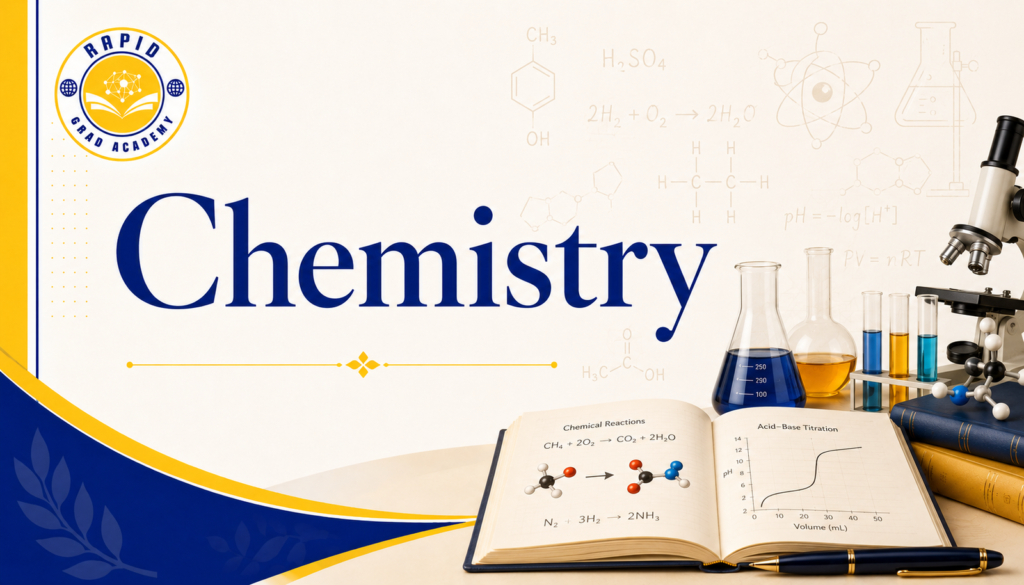

Chemistry

Matter and its transformations — from atomic structure and bonding to reactions, equilibrium and acids.

0.0
(0)
1 Enrolled

About Course

Chemistry explains what matter is made of and why it behaves as it does. This
course builds from atomic structure through bonding to reactions, and closes with the three questions
that determine whether a reaction is useful: how much energy it involves, how fast it goes, and how far
it proceeds.

The course is built around worked examples and explanations of mechanism. Where a rule exists, the
reason for it is given — because periodic trends, molecular shapes and equilibrium shifts all follow from
a small number of principles rather than requiring separate memorisation.

What you will study

  • Unit 1 — Matter and Measurement: classifying matter, states and phase changes, SI
    units, significant figures and dimensional analysis.
  • Unit 2 — Atomic Structure and the Periodic Table: the development of atomic theory,
    isotopes, electron configuration and periodic trends.
  • Unit 3 — Bonding and Molecular Structure: ionic, covalent and metallic bonding,
    Lewis structures, VSEPR shapes, polarity and intermolecular forces.
  • Unit 4 — Reactions and Stoichiometry: balancing equations, reaction types, the mole,
    limiting reagents and percentage yield.
  • Unit 5 — Gases, Liquids and Solutions: the gas laws, the ideal gas equation,
    solubility, concentration and titration.
  • Unit 6 — Energy, Rates, Equilibrium and Acids: thermochemistry, collision theory,
    Le Châtelier’s principle, pH and buffers.

How the course works

Most of your time is spent on teaching lessons with fully worked examples. Each unit includes two
interactive activities you complete on screen and one unit quiz marked automatically. A mid-course
assessment follows Unit 3 and a final assessment closes the course.

Practical work

This course covers the principles and calculations of chemistry. It does not include practical
laboratory work and does not provide procedures for experiments. Where laboratory safety is mentioned, it
is to explain why a principle matters. No experiment in this course should be attempted at
home.
If your programme requires a practical component, your provider will arrange it
separately.

Show More

What Will You Learn?

  • Classify matter and handle measurement, units and significant figures correctly
  • Explain atomic structure and predict properties from periodic trends
  • Determine bonding type, molecular shape and intermolecular forces
  • Balance equations and solve stoichiometry problems including limiting reagents
  • Apply gas laws, solution chemistry, equilibrium and acid-base principles

Requirements

  • Algebra I or equivalent. Comfort with rearranging equations, scientific notation and proportional reasoning.

Audience

  • Students completing a physical science credit, and anyone considering medicine, engineering, environmental science, pharmacy or laboratory work.

Course Content

Getting Started
<p>How this course works, what you will learn, and how you are assessed.</p>

  • Course Overview and Learning Objectives

Unit 1: Matter and Measurement
<h2>Unit Introduction</h2> <p>Chemistry is the study of matter — what it is made of, how it behaves, and why.</p> <p><strong>This unit establishes the two things every later unit depends on:</strong> a precise vocabulary for describing matter, and a reliable method for handling quantities.</p> <p><strong>The measurement content matters more than it looks.</strong> Chemistry answers are numbers with units, and a correct calculation reported in the wrong units, or to an unjustified precision, is wrong. <strong>Dimensional analysis, introduced in Lesson 1.4, is the single most useful technique in the course</strong> — it will solve problems in every unit that follows.</p> <h2>Unit Learning Objectives</h2> <p>By the end of Unit 1 you will be able to: - Classify matter and distinguish physical from chemical changes - Use SI units and apply significant figure rules - Distinguish accuracy from precision and calculate percentage error - Solve problems using dimensional analysis</p>

Unit 2: Atomic Structure and the Periodic Table
<h2>Unit Introduction</h2> <p>Everything in chemistry follows from atomic structure. <strong>Why elements react as they do, why the periodic table has the shape it has, and why bonding works — all of it comes down to electrons.</strong></p> <p>This unit traces how the atom was understood, establishes the modern model, and then shows how the periodic table's arrangement is a direct consequence of electron configuration rather than a convenient filing system.</p> <p><strong>The periodic trends in Lesson 2.4 explain most of Unit 3.</strong> Understanding <em>why</em> atomic radius decreases across a period means you will not need to memorise which elements form which ions.</p> <h2>Unit Learning Objectives</h2> <p>By the end of Unit 2 you will be able to: - Describe the development of atomic theory and the evidence for it - Determine subatomic particle counts and calculate atomic mass from isotopes - Write electron configurations - Explain periodic trends in terms of atomic structure</p>

Unit 3: Bonding and Molecular Structure
<h2>Unit Introduction</h2> <p>Atoms bond because bonded arrangements are lower in energy than separated ones. <strong>Everything in this unit follows from that, and from the electron configurations of Unit 2.</strong></p> <p><strong>The unit builds in a specific order, and the order matters:</strong> what kind of bond forms, how the atoms are arranged, what shape results, and what that shape does to the substance's properties.</p> <p><strong>Lesson 3.4 on intermolecular forces is the payoff.</strong> It explains why water boils at 100 °C when similar molecules boil far below zero — and that explanation connects directly to the properties of water covered in Biology.</p> <h2>Unit Learning Objectives</h2> <p>By the end of Unit 3 you will be able to: - Distinguish ionic, covalent and metallic bonding - Draw Lewis structures for molecules and ions - Predict molecular shape using VSEPR theory - Explain polarity and intermolecular forces</p>

Unit 4: Chemical Reactions and Stoichiometry
<h2>Unit Introduction</h2> <p>This unit is where chemistry becomes quantitative.</p> <p><strong>The mole is the central idea</strong>, and it solves a specific problem: reactions happen between individual particles, which are far too small to count, while laboratories work in grams, which can be weighed. <strong>The mole connects the two.</strong></p> <p><strong>Stoichiometry — calculating quantities in reactions — is the most examined topic in any chemistry course</strong>, and it is entirely a matter of dimensional analysis applied to a balanced equation. <strong>The technique from Unit 1 does all the work.</strong></p> <h2>Unit Learning Objectives</h2> <p>By the end of Unit 4 you will be able to: - Write and balance chemical equations - Classify reaction types and predict products - Convert between mass, moles and particles - Solve stoichiometry problems including limiting reagent and percentage yield</p>

Unit 5: Gases, Liquids and Solutions
<h2>Unit Introduction</h2> <p>Gases behave more predictably than solids or liquids, which is why their behaviour was described quantitatively first. <strong>The gas laws are among the oldest quantitative relationships in chemistry</strong>, and they follow directly from the kinetic molecular theory established in Unit 1.</p> <p><strong>Solutions matter because most chemistry happens in them.</strong> Reactions in the body, in industry and in the environment overwhelmingly occur between dissolved substances, and describing concentration precisely is a prerequisite for working with any of them.</p> <h2>Unit Learning Objectives</h2> <p>By the end of Unit 5 you will be able to: - Apply the gas laws and the ideal gas equation - Explain gas behaviour using kinetic molecular theory - Describe the dissolving process and factors affecting solubility - Calculate concentration and perform dilution and titration calculations</p>

Unit 6: Energy, Rates, Equilibrium and Acids
<h2>Unit Introduction</h2> <p>The first five units covered what reactions are and how much they produce. <strong>This unit covers whether they happen, how fast, and how far.</strong></p> <p><strong>Those are three different questions</strong>, and conflating them is the main conceptual difficulty. A reaction can release a great deal of energy and proceed immeasurably slowly. <strong>Diamond converting to graphite is energetically favourable and takes geological time.</strong></p> <p>The unit closes with acid-base chemistry, which applies equilibrium directly and connects to Biology, Earth Science and everyday measurement.</p> <h2>Unit Learning Objectives</h2> <p>By the end of Unit 6 you will be able to: - Distinguish exothermic from endothermic reactions and use enthalpy - Explain reaction rates using collision theory - Apply Le Châtelier's principle to equilibrium systems - Describe acids and bases and calculate pH</p>

Course Completion
<p>Final assessment and full-course review.</p>

Instructors

Rapid Grad Academy

Rapid Grad Academy

4.3
7 Students
25 Courses
No Review Yet
No Review Yet