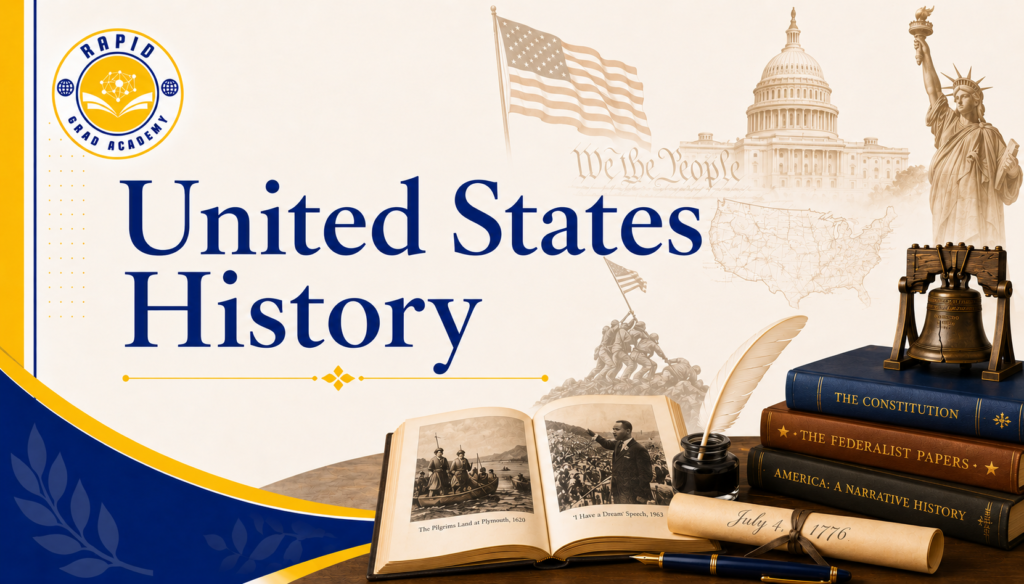

United States History

From Indigenous America to the present: how the United States was made, by whom, and at whose cost.

0.0
(0)
1 Enrolled

About Course

United States History traces the country from the societies that existed before
European arrival to the present. It is built around evidence and argument rather than a list of dates,
because the interesting questions in American history are contested ones.

The course takes seriously both what was achieved and what it cost. The founding documents stated
principles broader than their authors applied, and that gap — between stated principle and practice —
turns out to be the thread connecting abolitionists, suffragists, anti-imperialists and civil rights
campaigners, all of whom argued from the same words.

What you will study

  • Unit 1 — Foundations and Revolution: Indigenous America, colonisation, the
    construction of racial slavery, and the Revolution.
  • Unit 2 — Building a Nation: the Constitution and its compromises, the early
    republic, expansion and Jacksonian democracy.
  • Unit 3 — Division and Civil War: Manifest Destiny, the failure of compromise, the
    war, and Reconstruction.
  • Unit 4 — Industry and Reform: industrialisation, labour, immigration, Populism,
    Progressivism and overseas expansion.
  • Unit 5 — Boom, Depression and War: the 1920s, the Depression, the New Deal and the
    Second World War.
  • Unit 6 — Modern America: the Cold War, civil rights, social change and
    contemporary issues.

How the course works

Most of your time is spent on teaching lessons built around evidence and interpretation. Each unit
includes two interactive activities you complete on screen and one unit quiz marked automatically. A
mid-course assessment follows Unit 3 and a final assessment closes the course.

A note on difficult material and contested topics

Units 1, 3 and 5 cover slavery, Indigenous dispossession, war and wartime incarceration. These are
handled factually and without graphic detail. Where historians genuinely disagree, the course sets out
the competing cases rather than choosing between them — and for events of the last thirty years, whose
interpretation is still actively political, it presents what happened and what the disagreements are
rather than adjudicating them.

Show More

What Will You Learn?

  • Analyse primary sources and assess competing historical interpretations
  • Explain the constitutional system and how its disputes have recurred
  • Trace the causes and consequences of the Civil War and Reconstruction
  • Explain industrialisation, reform movements and America\'s global role
  • Apply historical context to contemporary debates

Requirements

  • World History is helpful but not required. Confident reading and willingness to weigh evidence.

Audience

  • Students completing their United States history requirement, and any learner who wants the historical context needed to follow current American politics.

Course Content

Getting Started
<p>How this course works, what you will learn, and how you are assessed.</p>

  • Course Overview and Learning Objectives

Unit 1: Foundations and Revolution, to 1783
<h2>Unit Introduction</h2> <p>American history does not begin in 1492. <strong>People had been living on the continent for at least fifteen thousand years</strong>, in societies ranging from small mobile bands to cities larger than London at the time.</p> <p>Starting the story at European arrival makes everything that followed look like settlement of an empty space. <strong>It was not empty</strong>, and the difference between those two framings shapes how the entire next four centuries are understood.</p> <p>This unit covers Indigenous America, the very different colonies Europeans established, the societies those colonies became, and the revolution that turned thirteen of them into a country.</p> <h2>Unit Learning Objectives</h2> <p>By the end of Unit 1 you will be able to: - Describe Indigenous societies before European contact - Compare the colonial regions and explain why they developed differently - Explain the origins and expansion of slavery in the colonies - Analyse the causes, course and outcomes of the American Revolution</p>

Unit 2: Building a Nation, 1783–1840
<h2>Unit Introduction</h2> <p>Winning independence was one problem. <strong>Governing was a harder one</strong>, and the first attempt failed.</p> <p>The Articles of Confederation created a national government deliberately too weak to threaten liberty — and too weak to function. The Constitution that replaced it was a series of compromises, some of which worked and one of which postponed a war.</p> <p>This unit covers how the United States was actually constructed: the arguments, the compromises, the first political parties, and the westward expansion that made the compromises unsustainable.</p> <h2>Unit Learning Objectives</h2> <p>By the end of Unit 2 you will be able to: - Explain why the Articles of Confederation failed - Describe the Constitutional Convention's major compromises - Explain federalism, separation of powers and the Bill of Rights - Analyse the early republic, expansion and Jacksonian democracy</p>

Unit 3: Division, Civil War and Reconstruction, 1840–1877
<h2>Unit Introduction</h2> <p>Between 1840 and 1861 the United States acquired enormous new territory, and every acquisition raised the same question: <strong>would slavery be permitted there?</strong></p> <p>That question destroyed every compromise attempted to contain it. This unit traces the sequence from expansion to secession, covers the war itself, and examines Reconstruction — the period when the country attempted to determine what emancipation would actually mean, and largely abandoned the attempt.</p> <h2>Unit Learning Objectives</h2> <p>By the end of Unit 3 you will be able to: - Explain Manifest Destiny and territorial expansion - Analyse the failure of sectional compromise - Describe the Civil War and the Emancipation Proclamation - Assess Reconstruction and explain why it ended</p>

Unit 4: Industry, Immigration and Reform, 1877–1920
<h2>Unit Introduction</h2> <p>Between 1877 and 1920 the United States became the world's largest industrial economy, absorbed roughly 25 million immigrants, and transformed from a mostly rural society into an urban one.</p> <p><strong>The wealth produced was extraordinary and so was the inequality.</strong> This unit covers how that happened, who paid for it, and the reform movements that emerged in response — most of which sought to regulate industrial capitalism rather than replace it.</p> <h2>Unit Learning Objectives</h2> <p>By the end of Unit 4 you will be able to: - Explain industrialisation and the rise of large corporations - Describe working conditions and the labour movement - Analyse immigration and urbanisation - Assess Populism, Progressivism and American expansion overseas</p>

Unit 5: Boom, Depression and Global War, 1920–1945
<h2>Unit Introduction</h2> <p>Twenty-five years containing a boom, the worst economic collapse in modern history, and the deadliest war ever fought.</p> <p><strong>This period reshaped the relationship between Americans and their government</strong> more than any since the Civil War. The New Deal established federal responsibility for economic security; the war established the United States as a global power. Both changes were contested at the time and remain so.</p> <h2>Unit Learning Objectives</h2> <p>By the end of Unit 5 you will be able to: - Describe social and economic change in the 1920s - Explain the causes of the Great Depression - Assess the New Deal and the debates about it - Describe American involvement in the Second World War and its effects at home</p>

Unit 6: Modern America, 1945–Present
<h2>Unit Introduction</h2> <p>The final unit covers the period that produced the country as it currently is: a superpower confronting another for four decades, a civil rights movement that dismantled legal segregation, and social and economic changes still being worked through.</p> <p><strong>The closer history comes to the present, the more contested it becomes</strong>, because the disagreements are live political disagreements rather than settled scholarly ones. This unit handles recent decades by setting out what happened and what the competing interpretations are, rather than adjudicating between them.</p> <h2>Unit Learning Objectives</h2> <p>By the end of Unit 6 you will be able to: - Explain the Cold War and its effects on American life - Describe the civil rights movement and its achievements - Describe social movements and political change since the 1960s - Analyse contemporary issues using historical context</p>

Course Completion
<p>Final assessment and full-course review.</p>

Instructors

Rapid Grad Academy

Rapid Grad Academy

4.3
90 Students
35 Courses
No Review Yet
No Review Yet