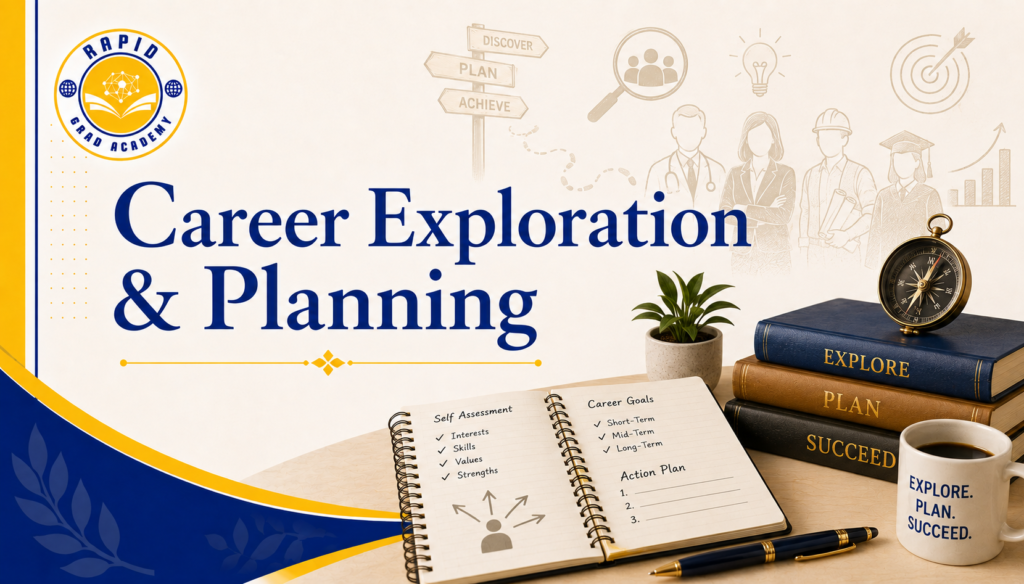

Career Exploration and Planning

How to work out what you might do, how to find out what it is actually like, and how to get there.

0.0
(0)
1 Enrolled

About Course

Career Exploration and Planning is a practical course about what happens after
school. It covers how to work out what might suit you, how to find out what work is actually like, what
the routes into it cost, and how to get hired and succeed once you are.

The course begins by dismantling the question you are most often asked. “What do you want to do?”
assumes careers are chosen once, that the choice should be obvious, and that not knowing means
something is wrong. None of that is accurate, and the pressure to produce an answer causes worse
decisions than admitting uncertainty does.

What you will study

  • Unit 1 — Knowing Yourself and the World of Work: interests, skills, values and
    working conditions; career clusters; how work is changing; and the myths worth correcting.
  • Unit 2 — Exploring Careers: researching occupations properly, evaluating sources,
    informational interviews and work experience.
  • Unit 3 — Education and Training Pathways: degrees, apprenticeships, certificates
    and licences; full costs and debt; choosing and applying.
  • Unit 4 — Employability Skills: communication, problem-solving, teamwork,
    adaptability, professionalism and how to evidence them.
  • Unit 5 — Getting Hired: finding openings, résumés, cover letters, interviews and
    networking.
  • Unit 6 — Succeeding and Planning Ahead: starting a role, workplace rights,
    understanding pay and benefits, and managing a career over decades.

How the course works

Most of your time is spent on teaching lessons with worked examples. Each unit includes two
interactive activities you complete on screen — building a self-assessment, planning research, drafting
applications — and one unit quiz marked automatically. A mid-course assessment follows Unit 3 and a
final assessment closes the course.

This course is educational and does not constitute financial, legal or employment-law advice.
Employment law and education finance vary substantially by country and region; check the specific rules
where you live. For decisions involving significant borrowing, consult a qualified adviser.

Show More

What Will You Learn?

  • Assess your interests, skills, values and working-condition needs
  • Research occupations properly and evaluate career information critically
  • Compare education and training routes, including their full costs
  • Build and evidence the skills employers consistently prioritise
  • Write applications, interview effectively and manage a career over time

Requirements

  • No prior knowledge required.

Audience

  • Students beginning to think about life after school, at any stage of certainty — including those who have no idea yet.

Course Content

Getting Started
<p>How this course works, what you will learn, and how you are assessed.</p>

  • Course Overview and Learning Objectives

Unit 1: Knowing Yourself and the World of Work
<h2>Unit Introduction</h2> <p>You will probably be asked what you want to do for a living before you have any reasonable basis for answering.</p> <p><strong>That question is badly framed.</strong> It assumes careers are chosen once, that the choice should be obvious, and that not knowing means something is wrong with you. None of that is accurate. Most adults change direction several times, many end up in work that did not exist when they were at school, and <strong>very few people knew at sixteen.</strong></p> <p>This unit replaces the question with better ones: what are you actually good at, what conditions suit you, what matters to you enough to organise your working life around — and what does the world of work currently look like.</p> <h2>Unit Learning Objectives</h2> <p>By the end of Unit 1 you will be able to: - Assess your interests, skills, values and preferred working conditions - Describe the career clusters and locate occupations within them - Explain how work is changing and what that means for planning - Identify and correct common myths about career choice</p>

Unit 2: Exploring Careers
<h2>Unit Introduction</h2> <p>Most people research careers badly. They read a job description, decide it sounds appealing, and proceed on that basis — which is roughly equivalent to choosing where to live from a property listing.</p> <p><strong>Job titles conceal enormous variation.</strong> Two people with the same title can have completely different working lives, and the things that determine whether you would like a job are rarely in the description.</p> <p>This unit covers how to find out what work is actually like: what to research, where to look, how to talk to people who do it, and how to get direct experience.</p> <h2>Unit Learning Objectives</h2> <p>By the end of Unit 2 you will be able to: - Research an occupation systematically - Evaluate the reliability of career information - Conduct an informational interview - Use work experience and job shadowing to test fit</p>

Unit 3: Education and Training Pathways
<h2>Unit Introduction</h2> <p>There is more than one route into almost every occupation, and the one presented as default is not always the best.</p> <p><strong>This unit treats education as an investment decision</strong> — something with a cost, a time commitment and a variable return, which deserves the same scrutiny as any other significant financial decision.</p> <p>That framing is deliberate. Education has value beyond earnings, and it also costs real money that has to be repaid from real income. <strong>Both are true, and only discussing the first leaves people unprepared for the second.</strong></p> <h2>Unit Learning Objectives</h2> <p>By the end of Unit 3 you will be able to: - Describe the main education and training pathways - Compare their costs, duration and outcomes - Assess whether a specific programme is worth its cost - Plan a realistic route into your chosen field</p>

Unit 4: Employability Skills
<h2>Unit Introduction</h2> <p>Employers consistently report that the hardest thing to find is not technical ability. <strong>It is people who communicate clearly, work well with others, solve problems without being told how, and turn up reliably.</strong></p> <p>This is not a soft alternative to real skills. Technical requirements can be taught in weeks; <strong>the skills in this unit take years to develop and are the reason people get promoted, kept during redundancies, and recommended.</strong></p> <p>This unit covers what those skills are, how to build them, and — equally important — how to demonstrate that you have them, since employers cannot see what you do not show.</p> <h2>Unit Learning Objectives</h2> <p>By the end of Unit 4 you will be able to: - Identify the employability skills employers consistently prioritise - Communicate effectively in workplace contexts - Apply problem-solving, teamwork and adaptability - Demonstrate professionalism and evidence your skills to others</p>

Unit 5: Getting Hired
<h2>Unit Introduction</h2> <p>Getting hired is a skill separate from being good at the job. <strong>People who would do the work well are regularly not hired because they applied badly</strong>, and people who interview well sometimes get roles they are not suited to.</p> <p>That is not an argument that the system is fair. It is an argument for learning how it works, because it operates whether or not you understand it.</p> <p>This unit covers finding openings, writing applications that get read, interviewing, and the networks through which a large proportion of hiring actually happens.</p> <h2>Unit Learning Objectives</h2> <p>By the end of Unit 5 you will be able to: - Find job openings through multiple channels - Write an effective résumé and cover letter - Prepare for and perform in interviews - Build a professional network and follow up appropriately</p>

Unit 6: Succeeding and Planning Ahead
<h2>Unit Introduction</h2> <p>Getting the job is the start. <strong>What happens next determines whether it becomes a career or a short episode.</strong></p> <p>This unit covers starting a new role well, understanding your rights and responsibilities at work, the practical financial side of employment, and how to manage a career over decades rather than months.</p> <p><strong>Careers are managed, not just experienced.</strong> People who review, adjust and act tend to end up somewhere they chose. People who do not tend to end up wherever circumstances put them.</p> <h2>Unit Learning Objectives</h2> <p>By the end of Unit 6 you will be able to: - Start a new role effectively - Describe workplace rights and responsibilities - Understand payslips, deductions and workplace benefits - Manage a career over time, including transitions</p>

Course Completion
<p>Final assessment and full-course review.</p>

Instructors

Rapid Grad Academy

Rapid Grad Academy

4.3
90 Students
35 Courses
No Review Yet
No Review Yet